




China’s “miracle economy” has become bleak. The nation’s gross domestic product barely increased in the post-Covid era and return on investment in Chinese markets continue to trend significantly behind U.S. markets. Domestically, the wealth of citizens has been stripped away in a major real estate crash.
“As sour as Americans are about the current economy, they should be profoundly grateful they don’t have China’s instead,” National Review said in April.
Despite being the second largest economy, China has gone from 78% the size of the U.S. in 2021 to 64% in 2024, according to the National Review. The post-Covid era has seen stagnation in multiple areas of China’s markets. Notably, China hosts the Wuhan Lab – the facility that Covid came from.
“While American equity markets have been on a tear during the same period, Beijing’s have shriveled,” National Review said. “Household consumption and private-sector investment have stalled out. Exports to the entire world — not just the United States — are stagnant.”
It’s not just the post-Covid era that has seen China trail behind the U.S. however. Investments within the MSCI China market benchmark greatly underperformed compared to those in the S&P500 between 2011 to 2025.
A chart depicting a $5,000 investment in both markets in 2011 shows a yield of $33,483 by 2025 in the S&P500 while only yielding $8,350 in MSCI China within same timeframe.
Commodity trader Jack Prandelli said in response to the chart “The biggest macro consensus of the last 15 years was ‘China rising.’ The biggest investing mistake was acting on it.”
While the Chinese market yielded a lower return on investment than the U.S. market over the last 15 years, the domestic economy has taken a major hit as well.
Chinese citizens often invest their savings into real estate. The real estate market is notably different than the U.S. however, as China is a communist/socialist country.
“Because China is a socialist country, all land is either subject to government ownership or collective ownership. In principle, municipal land is subject to government ownership and land outside cities is subject to collective ownership. However, one can obtain the right to use the land,” the Chinese law firm Lehman, Lee & Xu said.
When Chinese buy real estate (often in shoddily-constructed high-rise buildings) they are actually just leasing a concrete box in the sky.
“Since all land in the People’s Republic of China (“PRC”) belongs to the state, corporate entities and individuals are not permitted to own land although they may own the property above the land,” the Habitat International Coalition said.
Chinese who attained home “ownership” by parking their wealth in real estate have seen values crash, taking their life savings along with it.
China’s real estate market erased all gains from the last 20 years, according to the Federal Reserve Bank of St. Louis, citing numbers compiled by the Bank for International Settlements.
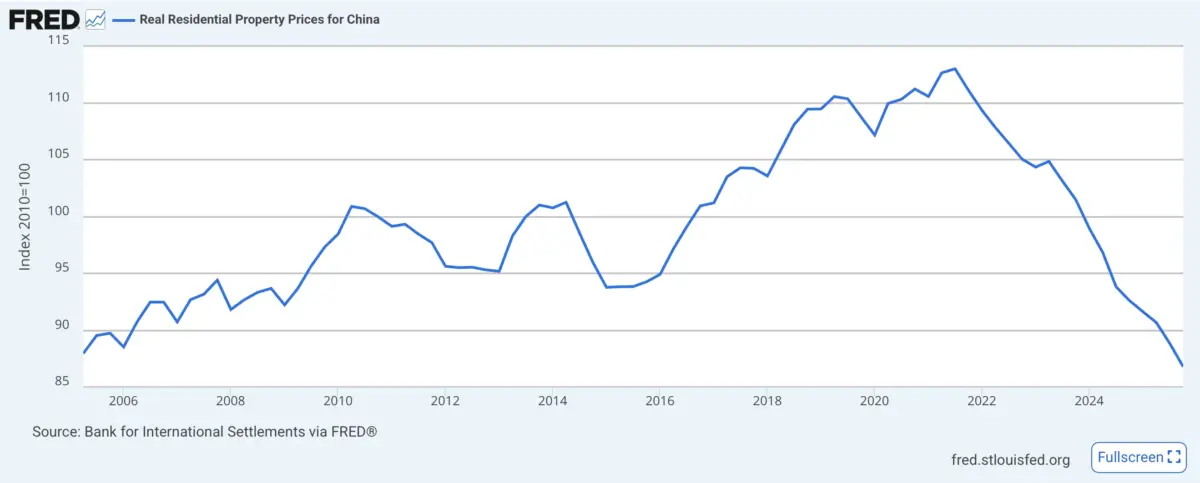
“Chinese house prices have crashed to their lowest level in 20 years, with homeowners who bought in 2005 now in the red as a debt crisis and oversupply wreak havoc on the market. Real residential house prices in China have been in free fall since Q3 2021, declining 23 per cent from their peak, according to data from the Bank for International Settlements (BIS),” news.com.au said on Friday. “In the world of property, losing nearly a quarter of real value in less than five years amounts to a major crash.”
Due to real estate being a central area of investment for Chinese citizens, a significant drop in property prices means a significant drop in Chinese citizens’ wealth.
“China’s real estate slump is in its fifth year, with no end in sight. Key indicators—sales, prices, construction starts and completions—continue to slide, while an estimated eighty million unsold or vacant homes clog the market. Many of the country’s largest private developers have defaulted on debts, and one of the largest state-backed firms, China Vanke Co., has been struggling for months to stave off a similar fate. One Chinese economist estimates that as many as 80 percent of developers and construction firms could “exit the market” in the coming years as the industry permanently contracts,” the Atlantic Council said in January.
Buildings in China have not been constructed on a free market supply-and-demand basis, but rather a command-and-control economy that invested heavily in projects which now remain vacant.
“The CCP spent trillions of dollars to inflate a property bubble, constructing tens of millions of homes that now lie vacant in ‘ghost cities’ where no one wants to live,” National Review said in April. “Excessive borrowing to finance state-ordered projects with lackluster returns has left Chinese companies and local governments in a severe debt crisis.”
The communist economy invested in such shortsighted real estate projects that some structures have had to be demolished before completion.
“The 15 buildings that stood next to each other for seven years were demolished in China. They were abandoned with rain damage,” USA Today said in their video description.
While lower property prices could spell a buying opportunity for Chinese citizens who do not yet own a home, a stagnating economy means citizens are likely unable to make the largest purchase of their life (a home).
“Over the past decade, China has seen a steady decline in its real GDP growth rate. This rate has declined from an average of 10% in 1980–2012 to around 7% in the seven years preceding the Covid-19 pandemic (2013–19) and to less than 5% in the years since China exited the pandemic. Many independent forecasts suggest that the Chinese economy will continue to slow in the coming years. The International Monetary Fund, for instance, projects that the country’s real growth rate could slow to around 3% by 2030,” the National Bureau of Asian Research said in 2025.
Beijing also set its lowest economic growth target in the last 35 years.
“China has cut its annual economic growth target to a range of 4.5%-5%, the lowest expansion goal since 1991 as it grapples with challenges both at home and abroad,” the BBC said in March. “It is the first time the target has been lowered since it was cut to ‘around 5%’ in 2023. A target was not set in 2020 due to the pandemic.”
While the official numbers coming out of China are not good, it has been widely documented that the CCP inflates its numbers to appear stronger than it really is.
“It is widely acknowledged that the official economic data released by the Chinese Communist Party (CCP) is unreliable. Not only do external observers doubt it, but even the Chinese citizens themselves and the CCP harbor skepticism,” Vision Times said in 2024.
Political gain drives Beijing’s dishonesty with its economic data, according to news outlet Medium.
“China’s statistical system is not a mechanism for presenting facts. It is a tool for constructing the narrative of political legitimacy,” Medium said in 2025. “The officially announced GDP figure of 134.91 trillion yuan for 2024 is nothing more than a manufactured illusion meant to stabilize a collapsing order.”
While numbers can be fakes, the situation on-the-ground cannot. A suicide epidemic has taken hold in China’s disintegrating economy.



2 Responses
I’m at the point where I’m just waiting for the housing market in the US to crash hard. These motherf-ckers wrecked the whole American illusion/dream years ago for millions of people, and honestly, I’d love to see it all collapse so everyone else finally feels the same disappointment the rest of us have been carrying.
Or you could get a job