


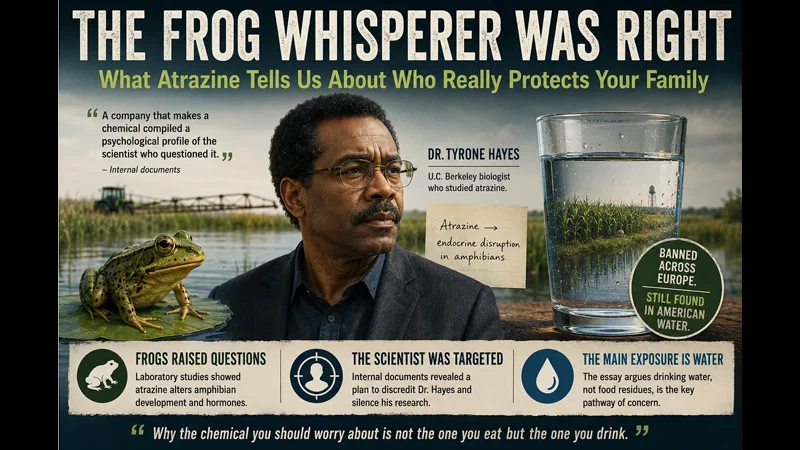


Why a weed killer banned across Europe still flows from American taps, why the scientist who exposed it was hunted by the company that made it, and why the chemical you should worry about is not the one you eat but the one you drink.
Few stories illustrate the collision between science, corporate power, and public health more clearly than the controversy surrounding atrazine.
Atrazine is the second most widely used herbicide in the United States. It is routinely detected in rivers, reservoirs, groundwater, and drinking water supplies across much of the country. It has been banned throughout much of Europe, remains the subject of ongoing scientific and legal disputes, and has generated decades of controversy over its potential effects on hormones, reproduction, development, and human health.
At the center of this story is Dr. Tyrone Hayes, a University of California, Berkeley biologist who was initially hired to study atrazine on behalf of its manufacturer. His findings raised questions the company did not want asked. What followed has become one of the most widely cited examples of conflict between independent scientific inquiry and the commercial interests surrounding a major agricultural product.
The debate over atrazine is not merely about a herbicide. It is about who decides what constitutes acceptable risk, how regulatory agencies evaluate evidence, and whether economic interests are given greater weight than public health when the two come into conflict.
When the Research Became Inconvenient
In 1997, Dr. Tyrone Hayes was hired by a predecessor company to Syngenta to study the effects of atrazine on amphibians. His research raised concerns that the herbicide could disrupt normal sexual development in frogs. In one of his most widely cited studies, published in the Proceedings of the National Academy of Sciences, genetically male frogs exposed to atrazine developed significant reproductive abnormalities. Some exhibited feminized characteristics, and some were capable of producing viable eggs after mating with male frogs.
The scientific findings were controversial. What made the controversy even more significant was what later emerged from internal corporate records.
Documents obtained during litigation and subsequently released through Freedom of Information Act requests revealed extensive efforts by Syngenta and its contractors to monitor, challenge, and discredit Hayes and his work.
Internal communications described strategies intended to undermine his credibility, track his public appearances, and respond to his scientific claims. Company records also referenced efforts to assemble networks of outside experts who could be called upon to defend atrazine and challenge adverse findings in the scientific and public policy arenas.
The existence of these documents became public through investigative reporting by The New Yorker, Mother Jones, and the nonprofit newsroom the Center for Media and Democracy, all of which reviewed court records and internal company communications released during litigation.
The use of corporate resources to investigate, profile, monitor, and attempt to discredit a scientist whose research produced findings unfavorable to a commercial product is unacceptable. The atrazine controversy became about more than frogs, endocrine disruption, or environmental toxicology. It became a case study in how large organizations respond when scientific findings threaten a product worth billions of dollars in annual sales.
As someone who was personally targeted for questioning the safety profile of mRNA vaccines during the COVID response, a vicious attack campaign that has since been documented in congressional reports, court filings, and government disclosures, the Hayes story is not merely historical. The tactics are instantly recognizable. When the science becomes inconvenient, the discussion often shifts from the data to the scientist.
What has changed since the atrazine controversy is not the strategy but the sophistication. The tools are more advanced, the coordination is more effective, and the ability to shape public perception is far greater. The objective, however, remains unchanged: isolate the dissenter, damage credibility, and ensure that the debate centers on the individual rather than the evidence.
What the science actually says
Hayes’s headline claim, complete sex reversal in frogs, has been the hardest to replicate, and industry-funded studies reported no such effect. But step back from that single dramatic image, and the broader picture is much stronger. Independent reviews, including meta-analyses by amphibian biologist Jason Rohr, who is not in anyone’s pocket, found that atrazine reliably disrupts amphibian biology: it alters gonadal development and sex hormones, suppresses immune function, raises infection rates, and changes behavior at concentrations you actually find in the environment. The specific “turns males into females” headline is debated. The conclusion that atrazine is a real endocrine disruptor is not.
Then came November 2025. A working group convened by the World Health Organization’s International Agency for Research on Cancer (IARC), the same body considered the gold standard for cancer hazard assessment, reviewed the evidence, and classified atrazine as “probably carcinogenic to humans,” Group 2A. They cited limited evidence in humans for non-Hodgkin lymphoma, sufficient evidence of cancer in animals, and strong mechanistic evidence that atrazine behaves like a carcinogen, causing oxidative stress, DNA damage, immune suppression, inflammation, and hormone disruption. This is the same category, by the same agency, that glyphosate landed in a decade earlier.
The counterpoint is that the largest American study of farm applicators, the Agricultural Health Study, did not find an overall link between atrazine and non-Hodgkin lymphoma in its 2024 update, though it did flag elevated cancer rates among those who apply the product diagnosed before age 50.
IARC weighs hazard, the question of whether something can cause cancer. EPA tends to argue about risk at typical exposures. Both can be partly right. But notice the asymmetry: the WHO’s cancer agency says probably carcinogenic, and the EPA continues to defend the chemical’s use.
Pregnancy and fetal development
Potential effects on fetal development warrant particular attention. A peer-reviewed study conducted in Indiana reported that higher atrazine concentrations in drinking water during pregnancy were associated with an increased risk of infants being born small for gestational age.
The increase in risk observed in the study was modest at the level of an individual pregnancy. However, small shifts in birth weight distributions can have significant public health implications when exposure occurs across large populations. A risk increase that appears minor for a single family may translate into thousands of additional affected births when millions of pregnant women are exposed.
Low birth weight and small-for-gestational-age status are not merely statistical outcomes. Both have been associated with increased risks of neonatal complications, developmental challenges, metabolic disorders, and adverse health outcomes later in life. For that reason, even relatively small changes in population-level risk deserve careful consideration when evaluating environmental exposures during pregnancy.
The desiccant debate
If you read this substack and other alternative media, you have read about the alarming and accurate reporting about pre-harvest desiccation: the practice of spraying a herbicide on a mature crop days before harvest to dry it down, which drives chemical residues straight into oats, wheat, bread, and legumes. That reporting is real. But the chemical at its center is glyphosate as well as some other bad actors, but it is not atrazine.
Atrazine is not a desiccant. Atrazine is a Group 5 photosynthesis inhibitor used early in the season on corn, sorghum, and sugarcane, usually before or shortly after the weeds and crop emerge. Its label requires a long gap between application and harvest, a 45-day pre-harvest interval for sweet corn forage, for example, and prohibits late-season spraying. So there is no equivalent of the glyphosate-on-oats story for atrazine, and no dataset of “atrazine desiccant residues,” because that is simply not how the chemical is used.
Here is the twist, though. Atrazine’s exposure route is in some ways sneakier than food residues.
You do not mainly eat atrazine. You drink it.
On the plate, atrazine is a minor actor. EPA’s dietary assessment concluded that the risk from atrazine residues in food did not exceed the agency’s level of concern. Trace amounts turn up in grain, milk, and meat because the chemical is fed to livestock, and year after year, USDA monitoring reports most sampled foods sitting below tolerance. EPA even tightened several atrazine food tolerances in December 2025. Fine. If atrazine were only a residue on your cornflakes, it would barely be worth an essay.
The primary route of exposure is through water, and that is what makes atrazine different from many other agricultural chemicals. Atrazine is highly mobile in the environment. It persists in soil long enough to be carried by rainfall and irrigation runoff, and it readily moves through the soil profile into groundwater. After spring application, significant quantities can wash into streams, rivers, reservoirs, and aquifers that supply drinking water for both rural and urban communities. According to EPA monitoring data, atrazine is one of the most frequently detected pesticide contaminants in both surface water and groundwater in the United States.
Once atrazine enters groundwater and surface water systems, it can persist for extended periods. Atrazine is relatively resistant to hydrolysis across the normal environmental pH range and is not readily degraded by sunlight. In surface waters exposed to sunlight, degradation may occur over periods ranging from days to months. In groundwater aquifers, where sunlight is absent and temperatures are lower, environmental persistence can extend for years. Germany banned atrazine in 1991, yet more than eighteen years later it remained one of the most frequently detected pesticide contaminants in German groundwater.
Atrazine also degrades into several metabolites, including desethylatrazine and desisopropylatrazine. These degradation products remain mobile in the environment, persist in groundwater, and are commonly detected alongside the parent compound in environmental monitoring programs.
The extent of contamination is well documented. A 2021 U.S. Geological Survey analysis of 442 streams detected atrazine in 55 percent of surface water samples and in 70 percent of groundwater samples tested. In major agricultural regions, particularly the Corn Belt, concentrations rise predictably following seasonal application, with peak levels occurring during late spring and early summer runoff events. An Environmental Working Group analysis estimated that approximately 30 million Americans in 28 states receive drinking water containing detectable atrazine residues.
These findings raise an important regulatory question: what level of atrazine exposure is considered acceptable in drinking water? The United States Environmental Protection Agency has established a maximum contaminant level of 3 micrograms per liter. By comparison, the European Union limits any individual pesticide in drinking water to 0.1 micrograms per liter, a standard thirty times lower than the U.S. limit. The substantial difference between these regulatory thresholds reflects differing interpretations of the available scientific evidence and differing approaches to precautionary regulation.
The economic consequences of atrazine contamination have also been significant. In 2012, Syngenta agreed to a $105 million settlement of a class-action lawsuit brought by more than one thousand community water systems serving millions of Americans. The settlement was intended to help offset costs associated with monitoring and removing atrazine from drinking water supplies. Although the company admitted no wrongdoing, the case highlighted the financial burden that pesticide contamination can impose on public water systems.
The potential public health implications extend beyond contamination alone. The Indiana birth-weight study discussed earlier evaluated atrazine concentrations in drinking water and reported an association between higher maternal exposure during pregnancy and an increased likelihood of low birth weight among newborns. As a result, drinking water remains one of the most important pathways for human exposure to atrazine, particularly for pregnant women, infants, and young children.Malone News is a reader-supported publication.
Why it ends up in the milk
The exposure pathway does not end with drinking water. Atrazine contamination can also enter the food supply through livestock. Dairy cattle consume water and feed produced in agricultural environments where atrazine is widely used. Because atrazine and its metabolites can accumulate in animal tissues, residues may subsequently be detected in milk and other animal products. As one review noted, human exposure occurs primarily through contaminated water and through foods, particularly animal-derived products with higher fat content.
Evidence for this pathway has been documented in multiple studies. A 2022 investigation of dairy farms in Argentina detected atrazine residues in 89 percent of raw milk samples tested, with some samples exceeding internationally established limits for human consumption. The authors concluded that the estimated risk associated with consumption of individual milk samples was low. However, the study confirmed that atrazine contamination can be transferred from agricultural production systems into the human food chain.
Data from the United States suggest that farming practices can substantially influence residue levels. In a study comparing retail conventional and organic milk products, researchers reported no detectable residues of the current-use pesticides examined in organic milk samples. In contrast, pesticide residues, including atrazine, were detected in a portion of conventionally produced milk samples. The same study also reported differences in the presence of other agricultural contaminants, including growth-promoting hormones and antibiotic residues.
At first glance, these findings appear inconsistent with federal monitoring data. The FDA’s pesticide residue surveillance program reported no pesticide violations in domestically produced milk and found no residues exceeding established regulatory tolerances. However, the two datasets were designed to answer different questions. FDA monitoring programs are intended to identify violations of regulatory limits. Research studies often employ more sensitive analytical techniques capable of detecting trace concentrations well below those limits. Consequently, a finding of no regulatory violations does not necessarily mean that no residues are present; it means that any residues detected fall below established enforcement thresholds.
The distinction is important. Regulatory compliance addresses whether a product meets legal standards. Exposure assessment addresses whether a chemical is present at all and, if so, at what concentration. These are related but separate questions.
The absence of detectable atrazine residues in the organic milk samples is consistent with the requirements of organic production. Organic certification prohibits the use of atrazine and other synthetic herbicides on feed crops and pastureland, thereby reducing the likelihood that residues will enter the production system. While no agricultural product can be guaranteed completely free of environmental contaminants, production methods can significantly influence the probability and magnitude of exposure.
For consumers seeking to reduce atrazine exposure, drinking water and dairy products represent two pathways over which individual purchasing decisions may have a measurable effect. Selecting water treatment systems capable of removing atrazine and choosing dairy products produced without atrazine-based agricultural inputs can reduce overall exposure from these sources.
Below is a table of what water purification systems eliminat or reduce atrazine from water sources:
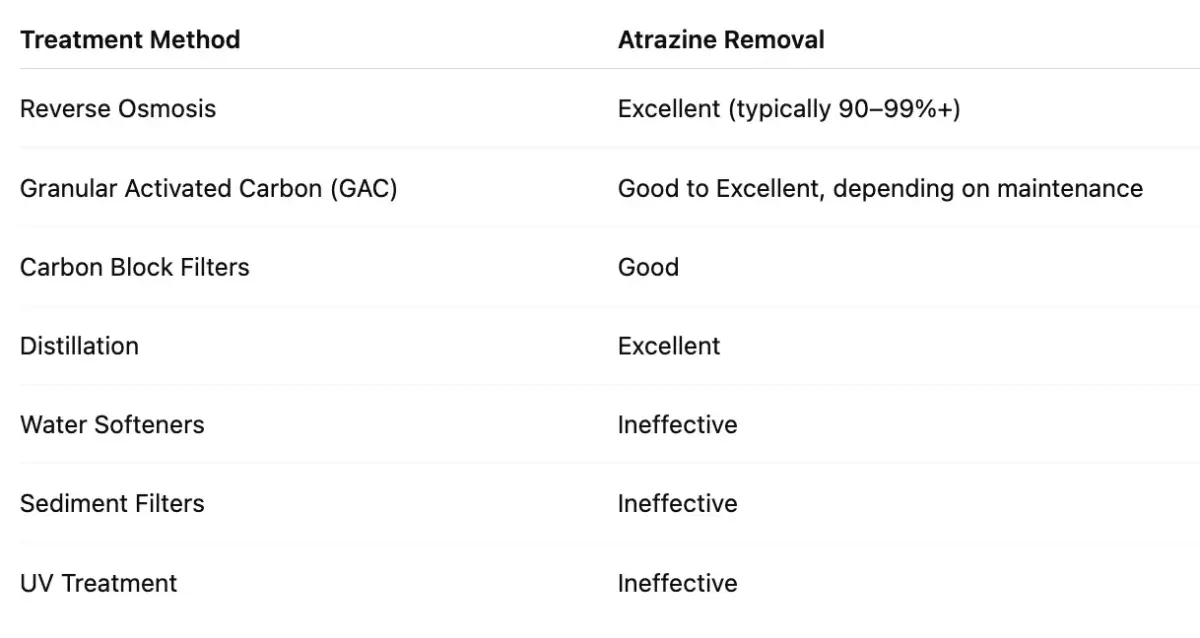
Recently, we purchased a countertop reverse osmosis unit to reduce microplastics in our drinking water. With a well depth of roughly 450 feet, atrazine contamination was not something we had given much thought. However, after digging into the literature, it became clear that atrazine and its metabolites can persist in groundwater for years and may, in some cases, be present even in relatively deep aquifers.
Reverse osmosis systems are expensive, but carbon filter-based units are not. So, if budget is a concern, that may be your solution – even if they don’t remove all of the residue.
The regulatory approaches taken by Europe and the United States are very different.
The European Union effectively banned atrazine in 2004 after concluding that groundwater contamination was widespread, difficult to control, and that available data were insufficient to demonstrate the chemical could be used safely under European environmental standards. The decision reflected the precautionary principle: manufacturers bear the burden of demonstrating safety before a product remains on the market.
The United States has historically taken the opposite approach. Atrazine has remained in use unless and until regulators determine that the evidence justifies additional restrictions. As a result, regulatory standards have shifted repeatedly over time as scientific assessments, political priorities, litigation, and administrative reviews have changed.
The history of the EPA’s ecological level of concern for atrazine illustrates this process. In 2016, EPA scientists established an aquatic ecosystem level of concern of 3.4 micrograms per liter. In 2020, the agency adopted a substantially less restrictive threshold of 15 micrograms per liter, a change that EPA later acknowledged reflected a policy decision rather than a purely scientific determination. Following legal challenges and further review, including consideration by a scientific advisory panel, the EPA finalized a revised concentration-equivalent level of concern of 9.7 micrograms per liter in 2024. The result was neither the more protective 2016 threshold nor the more permissive 2020 standard.
Regulatory debate surrounding atrazine remains unresolved. In 2026, the U.S. Fish and Wildlife Service finalized a biological opinion concluding that atrazine was not likely to jeopardize the continued existence of endangered or threatened species, a position that differed substantially from earlier federal analyses that had identified potential risks to a large number of listed species.
In response, environmental and public health organizations initiated additional legal challenges and renewed efforts to compel stronger federal regulation. As of mid-2026, petitions seeking more restrictive controls, including a complete ban, remained under active consideration.
Atrazine, MAHA, and the Limits of Political Will
Atrazine has become part of the broader Make America Healthy Again grass roots agenda. In May 2025, the MAHA Commission, chaired by Health and Human Services Secretary Robert F. Kennedy Jr., released its first report on childhood chronic disease and specifically identified atrazine as a chemical of concern. The report cited evidence from animal and wildlife studies indicating endocrine-disrupting effects and developmental abnormalities associated with exposure. For a chemical that remains registered and approved for use by EPA, its inclusion in a cabinet-level report was noteworthy.
Kennedy’s interest in pesticide regulation predates his government service. As an environmental attorney, he spent decades litigating environmental contamination cases and publicly criticized a number of agricultural chemicals, including glyphosate. During his presidential campaign, he repeatedly argued that pesticide exposures may contribute to the rise in chronic disease and called for substantially greater scrutiny of these products.
However, identifying a potential public health concern and implementing regulatory action are two different matters. The MAHA report documented concerns regarding atrazine and other agricultural chemicals but stopped short of recommending specific restrictions or regulatory changes. During the report’s release, administration officials emphasized that the goal was to evaluate scientific evidence rather than immediately alter agricultural practices.
The political realities surrounding pesticide regulation are difficult to ignore. Agricultural interests were not merely observers in the MAHA process; they had representation at the highest levels of the Commission itself.
As Secretary of Agriculture and a member of the MAHA Commission, Brooke Rollins has consistently positioned herself as an advocate for conventional agricultural practices and the chemical companies that support them. Industry sources and reporting indicate that agricultural interests successfully influenced portions of the Commission’s deliberations and final language, including discussion of glyphosate and atrazine. While the Commission was tasked with examining potential contributors to chronic disease, Rollins repeatedly emphasized the need to protect existing agricultural production systems and to reassure producers that major changes were not imminent. The result was a report that acknowledged concerns regarding these chemicals while stopping well short of recommending regulatory action.
The result has been a predictable conflict between public health concerns and entrenched agricultural interests. On one side are parents, physicians, scientists, and public health advocates raising questions about endocrine disruption, reproductive toxicity, developmental effects, and widespread contamination of drinking water. On the other are agricultural producers, chemical manufacturers, and the government agencies responsible for protecting an agricultural system that has become heavily dependent on products such as atrazine.
EPA continues to maintain that atrazine can be used safely under approved conditions, despite decades of scientific controversy, repeated regulatory disputes, documented groundwater contamination, and growing evidence of biological effects at exposure levels well below those traditionally considered toxic. The debate is no longer about whether atrazine reaches people and the environment. It is about how much evidence must accumulate before regulators act, and whether regulatory capture and economic considerations will continue to outweigh legitimate public health concerns.
As a practical matter, the regulatory status of atrazine remains unchanged. The herbicide continues to be registered for use in the United States, and EPA’s current aquatic concentration equivalent level of concern remains 9.7 micrograms per liter rather than the 3.4 micrograms per liter proposed by agency scientists in 2016.
The broader lesson extends beyond atrazine itself. Scientific concerns, regulatory findings, public advocacy, and political commitments do not automatically translate into policy change. Regulatory outcomes ultimately depend on whether elected officials and agency leadership are willing to expend the political capital necessary to alter existing policy. To date, despite years of scientific debate and public controversy, atrazine remains widely used throughout American agriculture.
What This Is Really About
At its core, this debate is not about atrazine alone. It is about how regulatory systems respond when scientific uncertainty intersects with powerful economic interests.
Atrazine remains one of the most widely used herbicides in the United States despite being banned or effectively prohibited in much of the developed world. The chemical has been associated with endocrine-disrupting effects in laboratory and wildlife studies, has been linked to adverse developmental outcomes in some epidemiological investigations, and has generated decades of scientific and regulatory controversy. At the same time, it remains strongly defended by both its manufacturers and by agricultural interests that rely on it as a production tool.
It is hard to dispute that atrazine contaminates groundwater, surface water, and drinking water supplies throughout large portions of the United States. That fact has been documented repeatedly by federal agencies, academic researchers, and water utilities.
The larger question is how much evidence is required before taking precautionary action. Europe answered that question more than two decades ago by concluding that widespread groundwater contamination alone justified removing atrazine from the market. The United States regulatory agencies reached a different conclusion and continue to rely on faulty regulatory thresholds, risk assessments, and mitigation measures to justify its continued use.
Citizens do not have direct control over federal pesticide policy, but they do have control over their own decisions. Understanding where exposure occurs, reviewing the underlying evidence, supporting independent scientific inquiry, and reducing avoidable exposures where practical are all reasonable responses to an issue that remains scientifically and politically contested. That means using water filters and buying organic milk or milk from local farmers that you know are not using atrazine in their fields.
History repeatedly demonstrates that public confidence in regulatory decisions depends on transparency, independent science, and the absence of conflicts of interest. Those principles should apply whether the subject is a pharmaceutical product, an industrial chemical, or an agricultural herbicide.
For now, the contamination remains. And the burden of deciding what level of risk is acceptable still falls largely on the public.
Because the government is not here to help…
Support Alex Jones by picking up an all-new Alex Jones Live t-shirt, or an awesome Trench War Dagger at TheAlexJonesStore.com.





2 Responses
A couple of weeks ago in NW Florida, Florida Power and Light conducted unannounced aerial spraying of herbicides along power lines resulting in chicken, livestock and massive bee hive kills. They have not even been forced to reveal what poison they were using since you know, fuel is way too expensive to send ground crews out to clear trees and brush. Fuck it, nobody cares and no accountability, just spray the shit out of the lines , adjacent properties and people living there – if they’re lucky there’ll be nobody left to complain.
> Dr. Tyrone
The memes write themselves.