


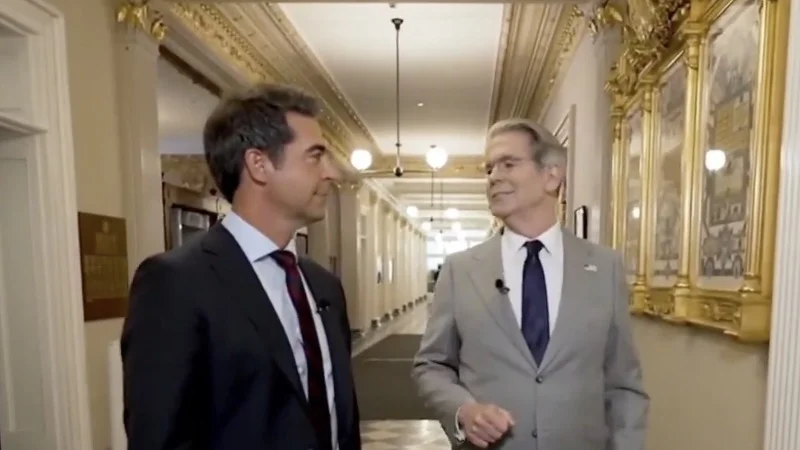


U.S. Treasury Secretary Scott Bessent attempted to reassure Americans that the country’s gold reserve in Fort Knox is still there, fully intact. Despite the claim, the federal official will not be checking if it’s actually true.
“The last major public inspection took place in 1974, when a congressional delegation and journalists were allowed inside. A smaller visit occurred in 2017 involving then-Treasury Secretary Steven Mnuchin and Kentucky lawmakers,” ZeroHedge said.
In a clip from Jesse Watters’ Fox News show, aired Monday night, Bessent talked about some of the history of the U.S. currency, which inevitably led to the discussion of precious metals previously backing the value of the dollar.
When showing off U.S. silver certificates, Bessent said “if any of these are still outstanding though, the silver or gold for them is still at Fort Knox waiting for them to be claimed, if so needed.”
“Have you visited Fort Knox,” Watters asked.
“I haven’t, I haven’t,” Bessent replied. “People on my staff has.”
The federal official then claimed all the gold is still in Fort Knox, despite it not being confirmed through an audit.
“We’re going to the treasurer’s office. The treasurer has been to Fort Knox, and I am happy to say all gold is present and accounted for,” Bessent said.
He then said the U.S. has the largest gold reserves in the world, at over $1 trillion at current market value.
In an article by Phoenix Capital Research which appeared on ZeroHedge, the topic of dollar debasement and the propaganda used to rewrite the past was discussed:
These are major statements by the Treasury Secretary. For one thing, Bessent puts to rest conspiracy theories that the U.S. no longer has its gold holdings in Fort Knox. This signals that the $USD remains strong as the reserve currency of the world, backed not only by the full faith and credit of the largest most dynamic economy, but also by the largest gold holdings.
As for the comment that the $USD “used to be backed by silver, sometimes gold,” this is a remarkable statement for many reasons.
First and foremost, rarely if ever do you hear major financial insiders talk about the fact that the $USD was previously backed by silver and gold. Granted the comment was made in regard to displays of the U.S. currency over the years, but this is still a major admission of a fact many Americans don’t know.
Moreover, in the context of concerns about inflation (76% of Americans cite higher costs of living as their biggest economic problem) the statement that the U.S. used to be backed by “silver, sometimes gold” is a very loaded statement. The $USD has lost ~87% of its purchasing power since abandoning the gold standard.
The massive inflation of the dollar is exhibited in how the federal government values their gold reserves.
“Federal law still prices gold at the statutory rate of $42.2222 per fine troy ounce, frozen since 1973. At that rate, Fort Knox’s holdings carry a book value of approximately $6.2 billion,” ZeroHedge said. “At spot prices that have recently traded near $4,500 per ounce, however, the same gold is worth on the order of $660 billion on the open market.”
The Gold Reserve Transparency Act of 2025 would “provide for the first credible audit of gold owned by the United States in decades, to upgrade the purity of gold to meet global market standards, and to conduct subsequent audits every 5 years.” It has not advanced since being introduced.
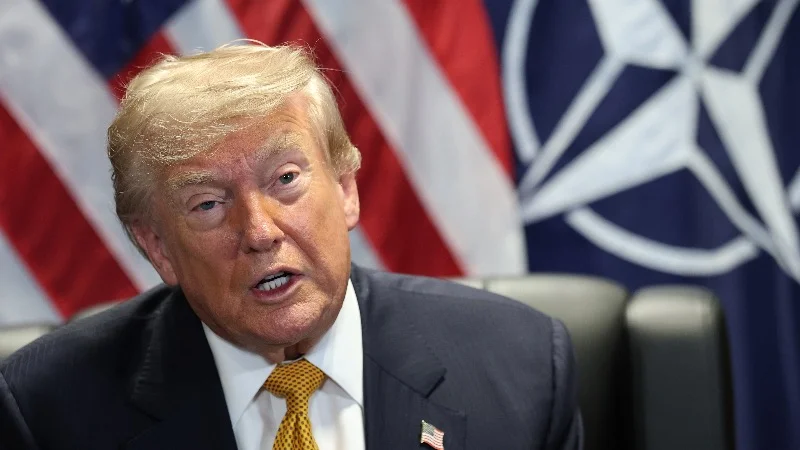
President Donald Trump himself has expressed an interest in investigating the existence of the purported gold reserve.
“Well, we wanted to go knock on the door (of) Fort Knox, a very thick door, and to see whether or not we have any gold in there…,” Trump said in a May 10 interview on Full Measure with Sharyl Attkisson. “It’s a very interesting question. Yeah, we played with that. I wonder if they left the gold in Fort Knox because they steal a lot.”

17 Responses
Um, ok
Trump is fake and is owned by globalists and Israel
It’s easy to account for 0 ounces.
” For one thing, Bessent puts to rest conspiracy theories that the U.S. no longer has its gold holdings in Fort Knox. ”
–what BULLSH’T!! Nothing was ‘put to rest’–and besides, Fort Knox is just ONE OF several places where America’s (what USED to be America’s) gold is (WAS?) stored.
The word ‘dollar’ is SUPPOSED to be a UNIT Of MEASURE–like ounce/pound/yard/quart/bushel etc.. So if you beLIEve you have “100 Dollars” in your wallet, the question that it begs is…What do you have 100 ‘dollars’ OF?? -Answer:…NOTHING!
Prior to March 9, 1933 when the Bankster’s Shill FDR got away with letting America’s gold be STOLEN, the greatest UNCONSTITUTIONAL Act EVER, a true LAWFUL ‘dollar’ was a certain amount of grains of silver or gold in COIN form with 10% of the coin’s weight in other metals. Article 1 section 8 has been Ignored and effectively Tossed– it says Congress has the power to have American (Lawful) money COINED–meaning of gold or silver. US federal law USED to define it this way: “Lawful money shall be construed to mean that which is coined of gold or silver by Act of Congress” (12 U.S.C. § 152). Before 1933 the paper money ‘script’ notes USED to have the PROPER wording on them saying that the note could be exchanged at any U.S. bank for it’s stated value IN GOLD or SILVER.
Treasury Secretary Scott Bessent says all US gold is present and accounted for.
Over $1 TRILLION in gold.<<<<<
The United States in in debt 40 TRILLION DOLLARS and if you count unfunded liabilities, it way over 100 TRILLION DOLLARS
And this clown is bragging about 1 TRILLION? That is not there
Add this to the very long list of Trump betrayals vvvvv
globalnews.ca/video/11032813/trump-says-hes-going-with-elon-musk-to-fort-knox-to-see-if-the-golds-still-there
Get a job, shitskin
Why not investigate Alex Jones’ phone for child porn? 🤬
He was caught live on steam in 2018 watching tranny porn 😭 Check out the news on it, it’s hilarious.
*stream
How would you know unless of course you were that tranny in the porn flick he was watching 😉
Looks like Bessent is in competition with Trump to see who can be the bigger liar
Get a job, shitskin
It’s just as protected and accounted for as your social security funds, no audits necessary and you don’t need to see it. Nobody can say when the last time either pile has been dipped into or…neither pile exists.
Makes perfect sense: Imaginary gold backing up an imaginary fiat currency fueling an imaginary AI economy with the imaginary consent of a people governed by an imaginary Constitution (as far as still being the supreme law of the land, that is). At least it is all logically consistent.
Except for the fact that the people are real; if the people were also imagined, everything would be fine.
hey I heard people’s bodies are transmitting MAC addresses and radio frequencies. Maybe nothing is real.
The debt is real, along with the interest on the debt, this I know for certain. Everything else is just a game of “Let’s Pretend”.
The Gold in Fort Knox was sent overseas decades ago, probably around the same time that silver was removed from circulation in 1965.
In 1964, a 1920’s silver dollar was worth $1.00. Today, it is worth about $60.00. That is very, very bad, because it has lost most of it’s value in just 60 years. That is why there are no more 5 and 10 stores which typically sold some household essentials for between 5 cents and 10 cents. Today, “Dollar Stores” don’t even have things that cost a $1.00….more like $2.00 to $10.00.
The fiat money is worthless today. Digital money will be the “wheelbarrow” money and will be exponentially worth less than paper!
The only thing that will save us is an EMP which will render computers, digital money, and tracking useless.
Digital currency is nothing more than an on/off switch and they will flip your switch at their leisure. The ultimate fraud, no wonder Trump loves it.