


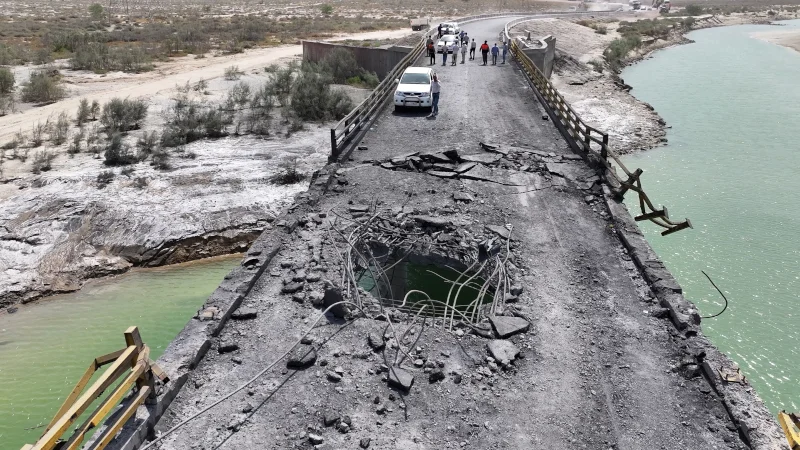


Communications and even the supply of drinking water has been severely impacted in some places of southern Iran, amid continuing US airstrikes on civic and national infrastructure, amid the seventh consecutive day of war.
“Hormozgan’s chief of communications and information technology says the US’s overnight attacks disrupted telecommunications in Bandar Abbas and Hajiabad, in the northern part of the province,” Al Jazeera reports
Authorities there have tallied at least 116 telecommunication towers which were taken out of service due to the US onslaught. This has resulted in outages and disruptions of fixed-line, mobile, and internet services, per Tasnim news agency.
This suggests the US is returning to a strategy which seeks to create destabilization within, targeting the ability of the public to communicate and access information, returning the situation to the early weeks of the war, which saw Tehran authorities themselves curb internet and some telecoms access for the citizenry.
It might also be that the US simply perceives infrastructure like telecommunications towers as utilized chiefly by the government and military, in a dual-use way, and so is ready to punish entire swathes of the country in order to cripple this ability.
It could be Washington still maintains the fantasy of fomenting a mass uprising against government leadership by imposing as much daily hardship and disruption, and economic pain as possible. Of course, the biggest squeeze is the blockade of Iranian ports and disallowing the country’s ability to sell oil.
The Wall Street Journal this week observed that it will continue to be ordinary Iranians feeling the immense strain:
Iran’s economy is already buckling under the combined weight of years of sanctions and soaring inflation. The conflict has intensified those pressures by damaging factories, disrupting trade and payments, shutting down internet access and further weakening the currency.
Consumer prices in June were up 88.6% from a year earlier, according to official statistics. Just in the first few days of July, the price of a tray of eggs in Tehran shot up by 40%, to the equivalent of $3.30, according to Iran’s Fars news agency, which is close to the paramilitary Islamic Revolutionary Guard Corps.
It seems the US wants to create the conditions of a return to the January economic protests, which resulted in thousands of deaths, which involved protesters and rioters clashing with police and security services, the latter which suffered deaths too as clearly some of the anti-government elements were armed.
According to more of the Iranian economy’s spiral via the WSJ report:
Iran’s gross domestic product is expected to shrink by 5.4% this year, according to forecasts by the International Monetary Fund prepared before the recent uptick in fighting.
According to Kahalzadeh’s calculations, only the top 3% of Iranian households are able to afford the full food basket recommended by Iranian health officials. Many families are buying basic groceries like rice, meat and pasta on credit via a government program. Others are eliminating meat from meals and purchasing staples one at a time as their wages lose value.
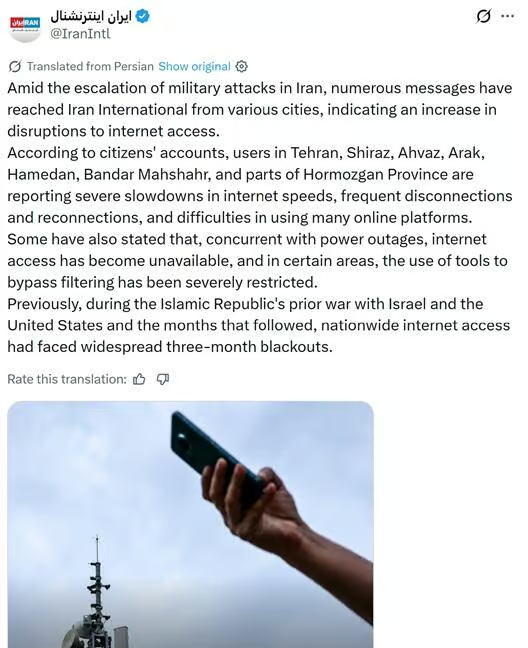
Below: Despite US bombs blowing up vital telecoms infrastructure, there’s a renewed effort by Saudi-Israeli aligned opposition media to accuse the regime of imposing a new internet blackout…
Meanwhile the war on infrastructure is only growing more aggressive and somewhat unprecedented. Power is one thing, but going after the population’s water supply?…
“Iranian authorities also said the supply of drinking water to several villages in the south had been cut off, accusing the US of striking power facilities and desalination plant pumps in the village of Bonji, according to Tasnim,” Al Jazeera writes.
Already Iranians nationwide have been urged to conserve electricity – for example by switching off air conditioners during peak hours, amid an ongoing severe strain on the power grid. Things look to get a lot worse for Iranians, and the outlook for broader war, before they get better.



8 Responses
Zionist Israel hates everybody. Especially white Christians.
I’m a bit torn on this issue. On one hand, I work for an Iranian bitch and I am glad they are bombing the shit out of her country. On the other though, the wanton destruction just seems like such a waste of time, money, resources and energy and counterproductive to human progress as a whole. Trump’s new nickname should be “the destroyer.”
And Teheran laughs.
What a damn expensive joke for the taxpayers this is.
Spot on!
Absolutely glorious. Nothing better than destroying sub-human filth Muslimes. Personally, if I had unilateral power I would create a bioweapon to eradicate Islam all together and then round up all the Marxist leftist filth who aid and abet Islam. Socialist/Marxists should flat out be exterminated. There is no coexistence with Islam or Socialist/Marxists.
You are clearly a marxist, who takes both muslim and jew cock right up your ass.
More homosexual anal fantasies projected by a sub-human piece of trash. I truly pray that you die in a car accident where your head is decapitated and ran over by a semi truck. Then the vehicle catches fire and your corpse burns to ashes. You are an immoral degenerate like all left-wing marxists. A complete waste of DNA.
I hope that one of your boyfriends fires a hollow point 9mm round right up your ass after you are caught cheating on him 🙂