

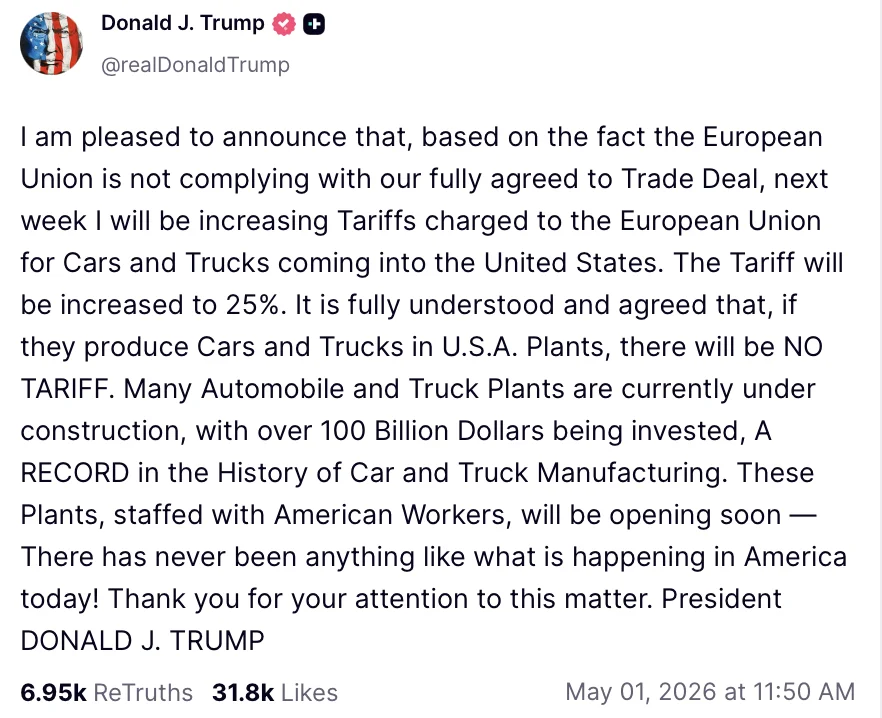
President Donald Trump announced Friday that he will be increasing the tariff on vehicle imports from the European Union next week.
In July Trump had set a 15% tariff on all goods from Europe in a deal which avoided a 30% tariff the President was threatening to impose if an agreement was not reached.
The July trade deal fell apart in the EU Parliament. In January the multinational European body suspended approval of the agreement over Trump’s interest in annexing Greenland, a Danish possession.
The foundation of July’s 15% tariff deal was also subject to change, and events over the last several months have caused the President to choose to increase the tariff rate.
“However in the following months tensions mounted over President Trump’s threats to annex Greenland, a self-governing Danish territory. In January the European Parliament in January suspended the approval of the trade deal,” the BBC said Friday. “The deal was eventually approved by the European Parliament in March, but only after a clause had been added, allowing it to be suspended if the Trump administration was deemed to have ‘undermined the objectives of the deal, discriminated against EU economic operators, threatened member states’ territorial integrity, foreign and defence policies, or engaged in economic coercion’.”
Particularly notable in the July trade agreement is the “foreign and defense policies” clause.
EU member states have refused to join in on Trump’s war in Iran after the President requested their aid.
French President Emmanuel Macron condemned the joint U.S./Israeli strikes on Iran and said that the operation was illegal and outside of international law.
Italy distanced itself from the Iran war. Prime Minister Giorgia Meloni said Rome does not intend to enter the conflict.
German Foreign Minister Johann Wadephul also said that Berlin will not join in on the war.
While not a EU member state, British Prime Minister Keir Starmer also distanced himself from the Iran war, although the UK has been involved in the conflict.
Trump noted in his Friday announcement that European vehicles manufactured in the U.S. will not be subjected to a tariff, but it should be mentioned that parts imported for their manufacture will still be tariffed. This is also the case with American vehicles manufactured in the U.S. with foreign-sourced parts.
The President said many new vehicle plants are now under construction, these will be additional to the existing facilities.
Mercedes Benz began manufacturing vehicles in the U.S. after opening a plant in 1995, BMW opened their U.S. plant in 1994 and Volkswagen in 2008 (although VW had manufactured in the U.S. previous to that with some breaks).
French vehicle manufactures Renault, Citroen and Peugeot have completely pulled out of the U.S. market by the early 1990s.
The conglomerate Stellantis owns Italian brands Fiat, Alfa Romeo, Maserati and Lancia which are not manufactured in the U.S.
Some vehicles from Stellantis’s American brands Chrysler, Dodge and Jeep are manufactured domestically. The conglomerate invested $13 Billion in November to expand its U.S. manufacturing.
American University’s Kogod School of Business compiles an annual “made in America auto index” which provides a breakdown and analysis of domestic vehicle manufacturing. Their 2025 report can be viewed here.