


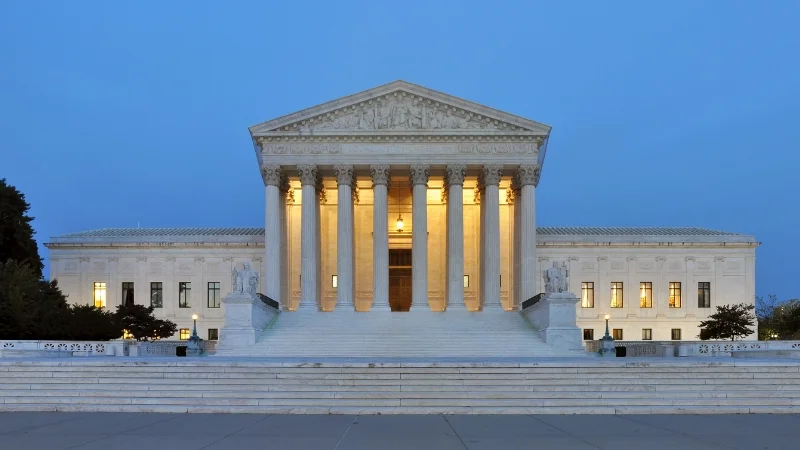


Lawmakers in Alabama and Tennessee will consider redrawing their state’s congressional maps after this week’s Supreme Court ruling that limits a section of the Voting Rights Act.
On Friday, the governors of both states called to convene special sessions to examine the boundaries of voting districts.
Alabama Gov. Kay Ivey said she has called a special legislative session that will being on Monday to address legislation to provide for “a special primary election for electing members of the U.S. House of Representatives and the Alabama State Senate in districts whose boundary lines are altered by court action.”
“By calling the Legislature into a special session, I am ensuring Alabama is prepared should the courts act quickly enough to allow Alabama’s previously drawn congressional and state senate maps to be used during this election cycle,” Ivey said in a statement.
Tennessee’s special session will begin on Tuesday.
“After consultation with the Lt. Governor, Speaker of the House, Attorney General, and Secretary of State, I believe the General Assembly has a responsibility to review the map and ensure it remains fair, legal, and defensible,” Governor Bill Lee said in a statement.
On Wednesday, the Supreme Court ruled Louisiana’s map that created a second supermajority black district was unconstitutional, because race cannot be used as the main factor in redistricting.
The majority 6-3 decision was written by conservative Justice Samuel Alito.
“Section 2 of the Voting Rights Act of 1965 … was designed to enforce the Constitution—not collide with it,” Alito wrote.
“Unfortunately, lower courts have sometimes applied this Court’s [Section 2] precedents in a way that forces States to engage in the very race-based discrimination that the Constitution forbids.”
Compliance with Section 2 can “provide a compelling reason for race-based districting,” but the section “does not impose liability at odds with the Constitution, and it should not have imposed liability on Louisiana for its 2022 map,” he continued, referring to the second black-supermajority district as “an unconstitutional racial gerrymander.”
Harmeet Dhillon, assistant US attorney general for civil rights, welcomed the opinion, saying that Wednesday was a “big day in constitutional law.”
The Voting Rights Act “remains intact, but to protect Americans AGAINST discrimination rather than requiring it,” she wrote on X.
The Rev. Al Sharpton, president of the National Action Network, said the decision is “a bullet in the heart of the voting rights movement.”
“The Supreme Court has not just weakened a law, it has humiliated and dismantled the life’s work of Dr. Martin Luther King Jr., [former civil rights activist and congressman] John Lewis, and every man and woman who marched, bled, and died for Black Americans to have an equal voice at the ballot box.”
Support Alex Jones by picking up an all-new Alex Jones Live t-shirt, a Trench War Dagger, or the Alex Jones Signature Faraday Bag Bundle at TheAlexJonesStore.com.

One Response
”It was always about ‘reverse’ discrimination and reparations” [paraphrasing Al Sharpton]