


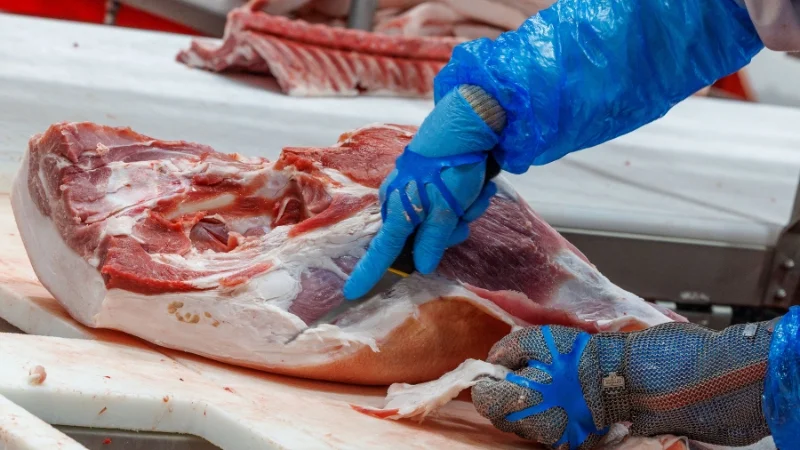


In my book, The Eggs Benedict Option (2022), I argued that our “plant-based future” would not arrive on the back of government meat bans, as many people fear.
For one thing, meat bans—and bans on animal products more generally—would be just too unpopular, and governments do have to pay attention to what people think, even as they try to manipulate it and “manufacture consent,” to borrow a phrase from Noam Chomsky, Satan torment his soul.
Among other evidence, I cited a poll from Australia that showed something like 75% of all men would rather lose five years off their life—it might have been ten actually—rather than give up their beloved steaks and ribs and pork chops. Quite right too. I’d probably go further and say I’d rather not live at all.
Market research shows people don’t want to give up red meat and eggs and dairy products, at least not given a free choice. This has been reflected in the dismal failure of “alternative protein” brands like Beyond Meat and Impossible Burger, which have had billions of dollars pumped into their hype campaigns, replete with celebrity endorsements and warm pats on the back for consumers—but still nobody wants to eat them. This lack of interest was on show hilariously during the pandemic, when meat products were cleared from supermarket shelves, leaving full rows of untouched “plant-based” burgers, shrivelled soy sausages and vegan “cheese.” In 2019, Beyond Meat shares were trading at more than $200. Now they’re about $0.66, which is about 66 cents more than they’re worth.
Companies that sell these products have been forced to pivot. Hard. Many have completely changed their marketing. If you saw Oatly’s appalling “Help Dad” campaign from a few years back, you’ll know exactly what I mean. A tragically unhip father enters a darkened kitchen late at night and heads for the fridge to grab an ice-cold glass of cow’s milk. A light turns on, illuminating a face in the corner of the room. “Well, well, well. What do we have here?” Broccoli hair and an unheimlich visage—it’s the poor father’s Zoomer son…
Consumer research says this is a better strategy. Instead of trying to convince people your ungodly slurry of oat-protein, vegetable oil, texturisers, flavorings and preservatives is a kind of milk that’s every bit as nutritious and tasty as the real thing, you make them feel ashamed to want the real thing in the first place. You tell them it’s destroying the planet and they have the full disapproval of all right-thinking people, especially the younger members of their family—and Bob’s your uncle, people are more inclined to plump for the plant-based option. Manipulation, pure and simple. The choice still remains, at least formally, but the guilty conscience and our wormish desire to be good and liked does the rest.
There are other means of manipulation, too. During the pandemic, our betters praised the supply-chain disruptions and price inflation as a spur to necessary “behavioural change.” An op-ed from The New York Times sticks out in my mind for the brazenness with which it pursued this angle. “You want to buy meat? In this economy?” was the headline.
“Inflation has the potential to drive welcome change for the planet if Americans think differently about the way they eat,” the author, Annaliese Griffin, wrote, as millions of Americans were struggling to put food on the table.
“While hunger and food insecurity are a very real problem in the United States and globally, middle- and upper-class Americans still have more choices at the grocery store than perhaps any food shoppers in history. Climate change has motivated some to eat less resource-intensive meat and more vegetables, grains and legumes, but this movement has not reached the scale necessary to bring needed change—yet.”
Griffin even praised the 1917 Lever Act, which gave the wartime government the power to requisition food to prevent hoarding…
As I said, though, I don’t think it will come to that. Governments, including the British government, which is committed to reducing meat consumption, do float the idea of things like carbon taxes to “offset” carbon emissions for “polluting” products, but again, I think these are more likely to be last-resort measures than first choice. There are plenty of other ways that people can be dissuaded or prevented from eating animal products, and what’s more the general public doesn’t even have to know what’s going on. One day they just wake up and meat is too expensive to have for supper, so they eat something else.
One way involves allowing the infrastructure that supports animal farming to decay.
Just last week, I saw an article in Farmers Guide, “the UK’s leading monthly farming magazine,” about the state of abattoirs in the country. Abattoirs—slaughterhouses—are closing here at a rate of 10% a year. Back in the 1970s, there were 2,500 abattoirs in the UK. Now there are fewer than 200, and numbers are still falling.
It’s not hard to imagine what the effects of continuing closures might be. Certainly it will affect the price of meat—livestock will have to be transported further for slaughter—but it’s also likely to reduce the availability of meat full stop. The National Farmers’ Union (NFU) has warned that 43% of farmers would stop selling their meat locally if their abattoir closed.
Conservative lawmakers, at least, are paying attention to the problem.
Farmers Guide explains.
“The NFU [National Farmers’ Union] recently hosted a roundtable in Parliament on support for small and medium-sized abattoirs, bringing together cross-party MPs to discuss the challenges facing the industry and the alarming number of closures seen across the country.
“The total number of UK abattoirs fell below 200 in 2024, with closures often due to the rising cost of official controls, energy and waste disposal bills and increasing red tape, according to the NFU.
“During the talks, MPs were told about the contributions small and medium-sized abattoirs make to the rural economy and independent food supply, including their role in the supply chain of pubs, butchers and local markets, as well as the additional services they provide to farmers such as private kills…
“The complexity of the regulatory environment was cited as one of the major issues facing smaller abattoirs, with multiple regulators and agencies providing inspections, including the EA, Trading Standards, planning authorities, the RPA and EHOs. MPs heard that contradictory inspections between agencies had been reported by abattoirs.”
A recent High Court case also found the government’s Food Standards Agency is illegally charging abattoirs over the odds to provide official controls and testing.
The problem has clearly been in the making for years, if not decades. But what’s also clear is that the British government has no real interest in solving it. Here’s an easy way the supply of meat can be strangled, without ever having to do something as unpopular as introduce a carbon tax or ban meat altogether. Sorry, meat just isn’t as plentiful as it used to be. Nothing we can do.
You could go even further. You could encourage rewilding—the conversion of farmland to managed “wild” land—and you could subsidize pasture to be turned into solar farms. You could put the squeeze on restaurants and the hospitality industry—which provide an essential stable demand for animal products—and you could drive rural pubs to close. You could discourage native food culture, promoting the food of, say, the world’s largest nation of vegetarians (that’s India) as healthier, tastier and less “exclusionary” to the hordes of brown people you’re importing into the country.
These are all things that are actually happening here, right now.
This is why I’ve said, again and again, that there needs to be a determined political movement to ensure the right to nutrient-dense animal foods, the foods on which our ancestors thrived and which are essential to our proper health, as well as our identity. In the US, you’re currently lucky enough to have “Make America Healthy Again,” which is already making strides in that direction. RFK Jr. has promoted whole milk—I’m told he even wanted to promote raw milk—and he’s inverted the demonic food pyramid, turning it up the right way for the first time in 50 years.
In states like Florida, lab-grown meat and other newfangled hellfoods are being banned. This annoys the hell out of libertarians and free-market fundamentalists, but their faith in the logic of the market is misplaced, as if we didn’t know that already. The market has spoken, but governments aren’t listening.




3 Responses
It’s like Alex said a while back and I agree a good ribeye steak or prime rib roast is as good if not better than sex with a women. And both will put you right to sleep at night. And when you get both its about as close to heaven as it gets.
Bill Gates is dying to see the state of Oregon ban hunting, fishing and animal slaughter.
Operation Starvation, field tested in Britain, coming soon to America.