


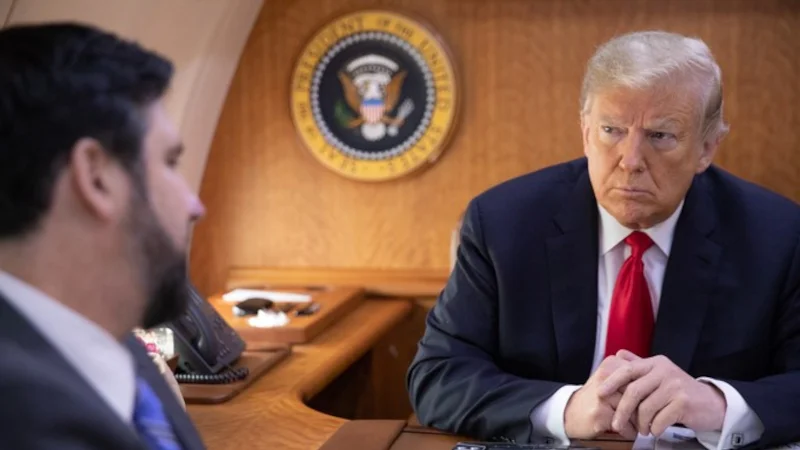


Tuesday night’s primaries in Indiana were not subtle. Five of seven Republican state senators who had blocked a congressional redistricting map favored by President Donald Trump lost their primary races to Trump-backed challengers. The message, delivered cleanly through the ballot box, couldn’t have been clearer.
Twenty-one Republicans in the Indiana Senate voted against a new congressional map that would likely have added two GOP-leaning U.S. House districts. Eight of those dissenters were up for reelection this cycle, and seven drew primary challengers who carried Trump’s explicit endorsement. By Tuesday night, the Associated Press had projected wins for at least five of those challengers. Only state Sen. Greg Goode managed to hold his seat among the targeted incumbents. The rest are heading for the exits.
Trump’s play here was neither complicated nor ambiguous. He targeted members of his own party, not for ideological apostasy or opposition to his signature policies, but for refusing to help the GOP fight back against decades of Democrat gerrymanders. It was a demonstration of leverage and political capital, and it worked.
The incumbents who lost weren’t rogue progressives or even moderate Republicans, either. They were conventional Republicans who had largely supported Trump on major national issues, and didn’t expect to become Trump targets. That calculation turned out to be wrong, and the lesson other incumbents will draw is obvious: the scope of what constitutes a disqualifying defection is wider than many assumed.
And there are likely to be other victims of Trump’s wrath.
In Kentucky’s 4th Congressional District, Trump has endorsed Ed Gallrein against Rep. Thomas Massie, a Republican who has broken with the president on the Iran war, tariffs, and quit a few other things. In Louisiana, Trump is backing Rep. Julia Letlow against incumbent Sen. Bill Cassidy, a physician who has pushed back against the administration’s “Make America Healthy Again” agenda. Both of those incumbents were watching Indiana returns Tuesday night and learning something about their own futures.
CNN’s Scott Jennings made it clear that the elections signaled who controls the Republican Party… It’s Trump all the way.
“He’s the boss of the party. He calls the shots in the Republican Party, and if you go against that, he will pour his wrath out upon you, and it doesn’t typically turn out well.” Jennings said.”If you look at what happened in Indiana tonight, and you’re Thomas Massie tonight, or you’re anybody else in a primary right now where Trump’s on the other side of you, you’ve got to be thinking, this is a bad night for me.”
The underlying data on Trump’s standing inside the party makes all of this easier to understand, if no less striking. Back in March, an NBC News poll found that Trump had a 100% approval rating among MAGA Republicans – a number that CNN analyst Harry Enten flagged as essentially without precedent. “You don’t have to be a mathematical genius to know you can’t go higher than one hundred percent,” Enten said. He was careful to note the distinction: “Now, there are some Republicans who disapprove of Donald John Trump, but they are not members of the Make America Great Again movement. The bottom line is this: if you are a member of MAGA, you approve of Donald Trump.”
That’s the context in which Tuesday’s results make complete sense. Trump’s grip on the GOP isn’t merely rhetorical or cultural — it is electoral and operational. Indiana showed that the president is willing to spend political capital on state-level races to advance his agenda, even if tangentially. For Republican incumbents nationwide who have crossed him or are contemplating doing so, that combination — willingness and effectiveness — should worry them.



12 Responses
I don’t understand being against Massie. He is what every rep should be. AIPAC and other jew money needs out of politics.
The Indiana election was a big deal. Challengers beat RINOs by huge amounts. The RINOs were unable to explain their disloyalty. There are a few more RINO senators there to be removed in 2 years, I wonder what they will say to avoid that.
Republicans v Democrats; can you tell me the difference between them ? I can’t see any difference in what they do. They just use different words, but the nation continues in the same direction, the downward path. They’re selling off this country and pumping up the others. That’s the EQUITY both parties are equally guilty of promoting.
I can tell you why they’re the same….big money from AIPAC.
I know why i voted for Trump and I know why i despise him now. I dont understand how people who supported the MAGA movement can continue to support Trump who, by his actions, has completely betrayed the MAGA movement.
Because most people don’t reflect upon their own beliefs, nor do they have the mental fortitude to acknowledge they may have been wrong in their thinking. The brain would rather double down and continue on a doomed path instead of evaluating and changing course. It’s supposedly a survival mechanism of some sort. I’m just going to roll my eyes and stop typing.
Trump doesn’t have any grip right now-he lost it. He will be lucky to escape the straight jacket after Nov 3.
Unfortunately he still has a grip on the party despite doing a ton of shit he campaigned against. It’s sickening to watch him ruin his legacy for a disgusting, war mongering, power hungry “ally”. BTW don’t you usually get some benefit from allies?
It’s not a totally accurate read on why it happened. The Indiana legislature has a Republican super majority. Most of those who lost in the primary have been in the legislature for several terms. It’s just that many of these candidates never get primary challenges. Same on the Democratic side. People came out in droves on both sides this time because they are tired of rising gas and grocery prices and see the political status quo as the problem. Many Democrats had challengers too. The difference was on the Dem side, there were three or more candidates in each race so an incumbent survived with forty percent of the vote or lower. In Congressional races, a nobody who didn’t even campaign or market himself got over forty percent of the vote against Victoria Spartz. Andre Carson on the Dem side would have barely won or lost if there were not three people running against him. There was not a major backing for redistricting in Indiana among grassroots Republicans because the plan was so poorly conceived. It’s more about the wages and prices and the Middle East war.
The candidates got challengers because of the redistricting issue. The at least 5 RINOs who lost were defeated by huge margins.
How was the plan “poorly conceived”? It gave specific boundaries which made more geographic sense and avoided racial lines. The existing boundaries were poorly conceived.
State primary elections are not about gas and grocery prices, which are lower there than in most states.
The party apparatus definitely funded the challengers on behalf of Trump but the majority of people voting against incumbents that were interviewed said they were voting because of the economy . Most people in Indiana didn’t give a screw about redistricting. It was conceived poorly because of the timing and the leadership had egg on their face because they looked like they were doing it for no other reason than Trump told them to, which they did. Redistricting is usually done after elections. not before. It’s the reason it failed not because it did or didn’t need to be done. Republicans looked no different than Democrats pulling a political dirty trick. Yes, primaries are usually not about an economy and Indiana’s isn’t as bad as most states, but many lower middle class and poor people didn’t see it that way and said so when questioned by local media. The challenges to the status quo was on both sides of the aisle. I’m conservative as well but saying the election was totally about redistricting is disingenuous and inaccurate. Trust me, no Indiana voter will care about come November as most didn’t this time around, except for the Trump can do no wrong voters.
…The incumbents who lost weren’t rogue progressives or even moderate Republicans, either. They were conventional Republicans
Oh please, that sounds just like that lgbtq+wewanttofuckyourchildren crowd with your divisionary crap.
It is not like they are 1-AA to begin with.
They are just simply no damn good.