


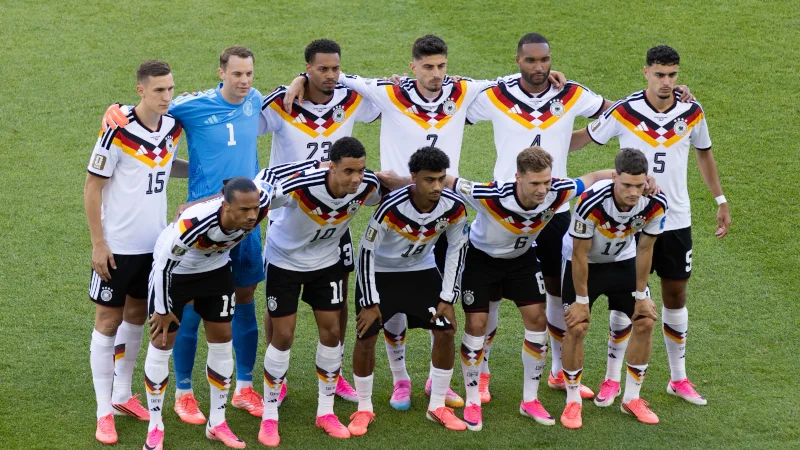


“Germany’s 2026 World Cup squad built on African roots,” read the headline of an article published by Deutsche Welle days before the team was knocked out of the international tournament by Paraguay in humiliating fashion.
The German team was routinely praised for its “diversity,” as roughly half of the players boasted multinational backgrounds, including eight with African heritage, and four others with Turkish, Balkan, Kurdish, and Serbian ties.
While all but one player was born in Germany, many of their parents migrated from Sierra Leone, Burkina Faso, Nigeria, Ivory Coast, and Ghana. Most of their sons only visited their “homelands” later in life.
The first African to play for the German national soccer team was Gerald Asamoah who appeared in the 2006 World Cup.
“Today we have great diversity in the team, which symbolizes a new generation of German players,” UN General Assembly President Annalena Baerbock told Deutsche Welle.
EVERY penalty from Germany vs Paraguay in their Round of 32 showdown 🎬 pic.twitter.com/dhlVvbCi1Q
— FOX Sports (@FOXSports) June 30, 2026
In 2024, German head coach Julian Nagelsmann condemned the results of a survey in which 21% of respondents told public broadcaster ARD they wanted to see more white players on the national soccer team.
“It is racist. I feel that we need to wake up,” Nagelsmann stated.
“There are people in Europe who’ve had to flee because of war, economic factors, environmental disasters, people who simply want to be taken in.”
Meanwhile, politicians and supporters of the Alternative for Germany party (AfD) refer to the German team as the “rainbow squad,” criticizing the organization for promoting racial diversity, LGBTQ+ issues, and a progressive social agenda.
“The early exit of our national team from the World Cup feels like a bitter reflection of what’s going wrong in the federal government,” MEP Petr Bystron (AfD) wrote on X this week.
“Instead of a genuine culture of performance, hard work, and an unwavering will to win, we see excuses, sugarcoating, and the eternal search for blame elsewhere—at the referee, the system, the opponent, but never at themselves.”
Interestingly, France is the largest talent exporter at this year’s World Cup. According to data compiled by Le Monde and The Athletic, there are 99 French-born players competing in the World Cup, but 76 have utilized FIFA eligibility rules to represent other nations — predominantly in Africa and the Caribbean.
Over half of the 26 players on France’s national team claim multinational heritages, including 12 with African backgrounds.
Compare that to powerhouse teams like Mexico, which only has five players of multinational heritage (Argentina, Spain, Colombia, U.S.), or the Japanese squad, with only three multinational members.
Germany’s World Cup history is one of dominance, having reached the final match eight times in the post-War era — more than any other nation.
Virtually all of those squads shared a common bond: rich, unifying German pedigree.

3 Responses
Krauts are embarrassing.
The Hitler guilt has thoroughly destroyed the Germans. Not many men left in that nation
Jew media war propaganda pushed the guilt.