


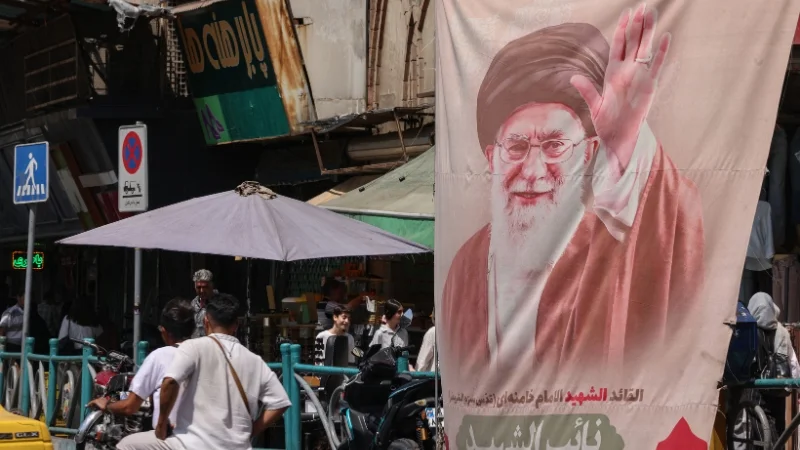


The US launched a wave of fresh strikes against Iran on Saturday, after Iranian attacks on Jordan killed two US soldiers.
Two soldiers were killed, one remains missing and at least four were injured during an Iranian attack on Muwawffaq Salti Air Base in Jordan on Friday.
“Today at 6 p.m. ET, U.S. forces began launching new airstrikes against Iran at the Commander in Chief’s direction,” US Central Command (CENTCOM) announced in a statement on Saturday.
Speaking after the launch of the latest attacks, President Trump said the deaths of US soldiers were “a shame,” but the soldiers gave their lives to prevent Iran from acquiring a nuclear weapon.
He added that the deaths “[show] you just how bad [the Iranians] are.”
President Trump said he would speak to the families of the two soldiers.
Saturday’s attacks targeted Iranian military coastal surveillance, air-defense facilities, maritime assets, and missile and drone sites.
Revolutionary Guards Corps positions were also attacked.
The main aim of the strikes was to further hamper Tehran’s ability to “threaten commercial shipping in the Strait of Hormuz,” CENTCOM said.
Yesterday, Alex Jones Live reported that the Trump administration is sending dozens of refueling planes to Israel in advance of a significant escalation of military operations against Iran.
Sources spoke to Axios and said President Trump is considering “a massive offensive in Iran that would be wider in scope than the current strikes around the Strait of Hormuz.”
“Among the options being considered are bombing Iranian infrastructure facilities like power plants, conducting more attacks on Iran’s nuclear facilities in order to bury Iran’s enriched uranium even deeper, and bombing the Pickaxe Mountain underground site that is suspected to be a facility in the making,” Axios reports.
The sources said President Trump has yet to make a final decision on escalating strikes, but it could come within the next few days.
The US currently has 30 refueling planes at Ben Gurion International Airport near Tel Aviv and around the same number in Ramon Airport in southern Israel.
The plan is to send several dozen more in the coming days, probably to Ben Gurion, because it is the safest location for them.
On Thursday this week, the US struck targets in the Strait of Hormuz and across southern Iran for the fifth day in a row.
The US military hit bridges around Bandar Abbas, a center of operations for the Revolutionary Guards Corps near the Strait.
Iran responded with missile and drone attacks on US bases in Jordan, Qatar, Bahrain, Iraq and Kuwait, and claimed it attacked a US base in Syria that American forces withdrew from months ago.
Iran also hit a power plant and a desalination facility in Kuwait.
The vast majority—90%—of Kuwait’s drinking water comes from desalination, a process that involves removing salt from seawater.
Other Gulf nations rely on desalination to a similar extent.
Eight-six percent of Oman’s drinking water and 70% of Saudi Arabia’s comes from desalination.
The New York Post notes, “Hundreds of desalination plants sit along the Persian Gulf coast, putting systems that supply water to millions within range of Iranian missile or drone strikes. Many desalination plants are in the same facilities as power stations, meaning attacks on electrical infrastructure could also hinder water production.”
Iran has targeted desalination plants in the region since the early days of the current war, which began at the end of February.
In 2010, CIA analysts concluded that attacks on desalination plants could trigger crises in Gulf states that last months if critical infrastructure is destroyed.
More than 90% of the entire region’s drinking water comes from just 56 plants, and “each of these critical plants is extremely vulnerable to sabotage or military action.”

2 Responses
Trump just wants crony capitalism and American soldiers deaths.
Proof is his refusal to crush the enemies viperous den called Teheran.
End of story.
The author CCD is an obvious zio-neocon propagandist.