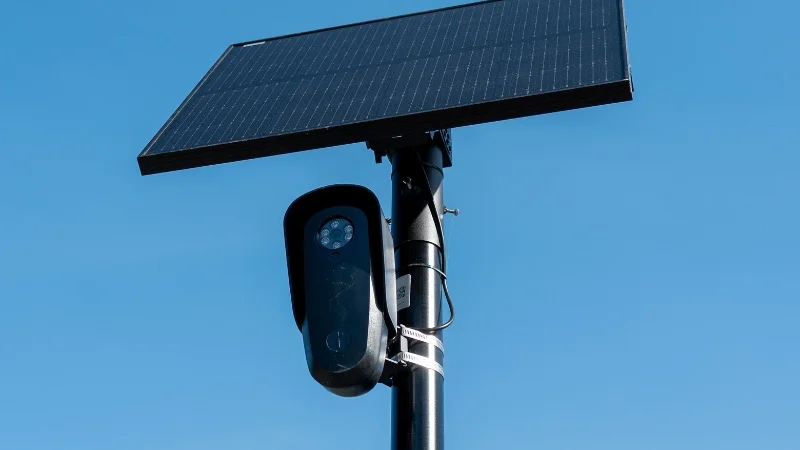


While talk of the surveillance grid often centers around Orwellian government aspirations, the private corporate sector has perhaps embraced prison planet technology to a far greater degree.
While companies like Flock Safety attain contracts with municipalities to instal their surveillance equipment on public property, private properties are another venue for the spy grid.
“Private camera networks are beginning to emerge in cities across the U.S. which operate outside the boundaries of companies who provide surveillance cameras to local governments under contract,” Biometric Update said Friday. “Rather than wait for a municipal contract, these companies install cameras through agreements with private property owners and financing from groups outside government.”
This private relationship prevents the public from pushing back against the surveillance technology.
“Police can later seek access to footage and analytical tools from systems assembled without a city purchase or public vote, but by then, the surveillance network may already be operating at scale,” Biometric Update said. “The emerging model does not automatically evade local law. Police access can still trigger surveillance ordinances and other restrictions. It does, however, move the initial decision to install cameras outside the municipal contracting process that has allowed communities to challenge companies such as Flock Safety.”
Biometric Update gave an example of firms which they say engage in the practice of deploying surveillance tech on private properties:
Orchestra is the clearest new example. The San Francisco startup is installing street-facing cameras free on private businesses while building an AI system capable of searching footage and following people across different locations without using facial recognition.
While surveillance tech that faces public areas is being deployed on private properties, privately owned stores that are open to the public, such as grocery stores, are increasingly turning to facial recognition biometrics to track and categorize shoppers.
“Facial recognition systems are scanning shoppers as they enter a growing number of Grocery Outlet stores in the San Francisco Bay Area, comparing their faces against watchlists of people suspected of theft, violence, or other unlawful conduct,” Biometric Update said Sunday.
Regarding the technical details on how the system works, Biometric Update said:
SAFR Guard is an AI-powered security solution for the retail loss prevention and asset protection market to prevent shoplifting and retail crime before it happens.
SAFR Guard is a product of SAFR LLC, a subsidiary of RealNetworks.
Cameras at participating stores capture facial images as customers enter and create encrypted biometric templates inside the camera. Those templates are compared with an in-camera watchlist. A potential match is sent for additional verification before the retailer receives an alert.
Retailers provide SAFR with images and descriptions of incidents involving people they suspect of illegal conduct. SAFR says it reviews and approves submissions before they are added to a watchlist.
The system may also share selected records concerning suspected violence or high-dollar thefts with other participating retailers in the same geographic area.
SAFR says the facial recognition template generated for a shopper who does not match a watchlist is held inside the camera for no more than one second and then deleted.
Its privacy policy, however, says encrypted images of people who are not designated as subjects of interest can be retained for as long as 30 days. Camera footage is also stored locally for 30 days so retailers can review incidents and create watchlist records.
Images and incident information concerning people designated as subjects of interest can be retained for up to 12 months. Some facial recognition records may be kept longer if SAFR reviews them and determines continued retention is necessary.
Grocery Outlet is not the first supermarket chain to deploy facial recognition technology to monitor its customers. Wegmans made headlines in January for announcing a similar system.
“Persons of interest are determined by our asset protection team based on incidents occurring on our property and on a case-by-case basis, by information from law enforcement for criminal or missing persons cases. We do not share facial recognition data with any third parties, nor do any third parties have access to the data,” Wegmans said on their website.
T-Mobile, Amazon and Target have also used facial recognition for years. The three faced lawsuits over the practice in 2024.
While private companies that deploy surveillance technology cannot make arrests or issue indictments, they can provide law enforcement the information to do so.
There has been many cases of AI surveillance technology creating false positive reports, leading to wrongful arrests of innocent people who get ensnared within the algorithm.