


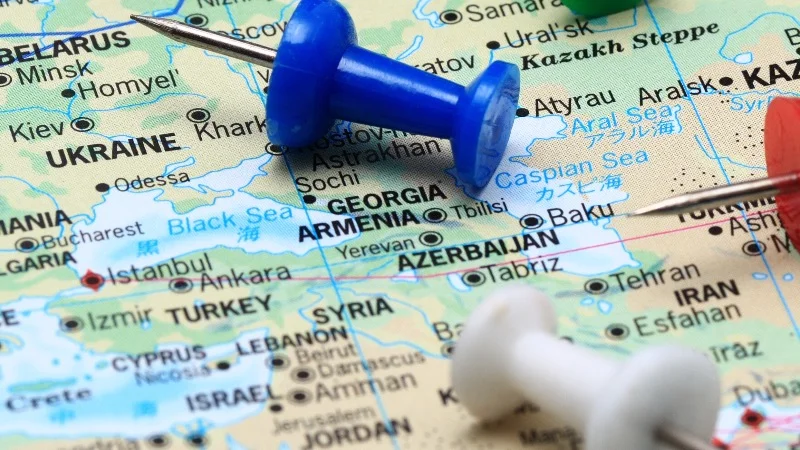


The Ukraine war has effectively merged with the Iran war, pitting two different world power groups against one another. The U.S. and NATO are backing a proxy war against Russia via Ukraine, while Russia and China are backing a proxy war against the U.S. and Israel via Iran.
On Friday Iran’s Foreign Ministry announced that Ukraine attacked an Iranian commercial ship in the Caspian Sea, killing one sailor and injuring another. The Wall Street Journal reported the landmark military operation in an article Monday with the headline beginning with “Two Wars Converge…”
Ukraine’s Dictator Vladimir Zelensky traveled to Saudi Arabia in March, shortly after the start of the Iran war. The embattled ruler initiated a diplomatic relationship which strengthened alliances across theaters of war.
The Atlantic Council reported March 31:
As the Iran War focuses international attention on the Middle East, Ukrainian President Volodymyr Zelenskyy traveled to the Gulf region in late March on a whirlwind tour that showcased wartime Ukraine’s rising military profile and growing geopolitical clout.
The Ukrainian leader’s flying visit involved high level stop-offs in Saudi Arabia, the United Arab Emirates, and Qatar. Since the outbreak of hostilities in the Middle East almost a month ago, all three Gulf states have sought Ukraine’s help to defend against Iranian drones. Kyiv initially responded by sending a number of drone interception teams to bolster regional air defenses. Zelenskyy’s recent trip aimed to build on these fledgling partnerships.
Initial results are promising. While visiting the region, Zelenskyy signed a series of what he termed as “historic” security agreements with his Gulf counterparts. While no details have been released, it is believed that these agreements envisage Ukraine sharing the country’s anti-drone experience and technological expertise in exchange for benefits including financial support, secure energy supplies, and strategic investments. There is also thought to be considerable mutual interest in developing longer term partnerships across the defense and tech sectors.
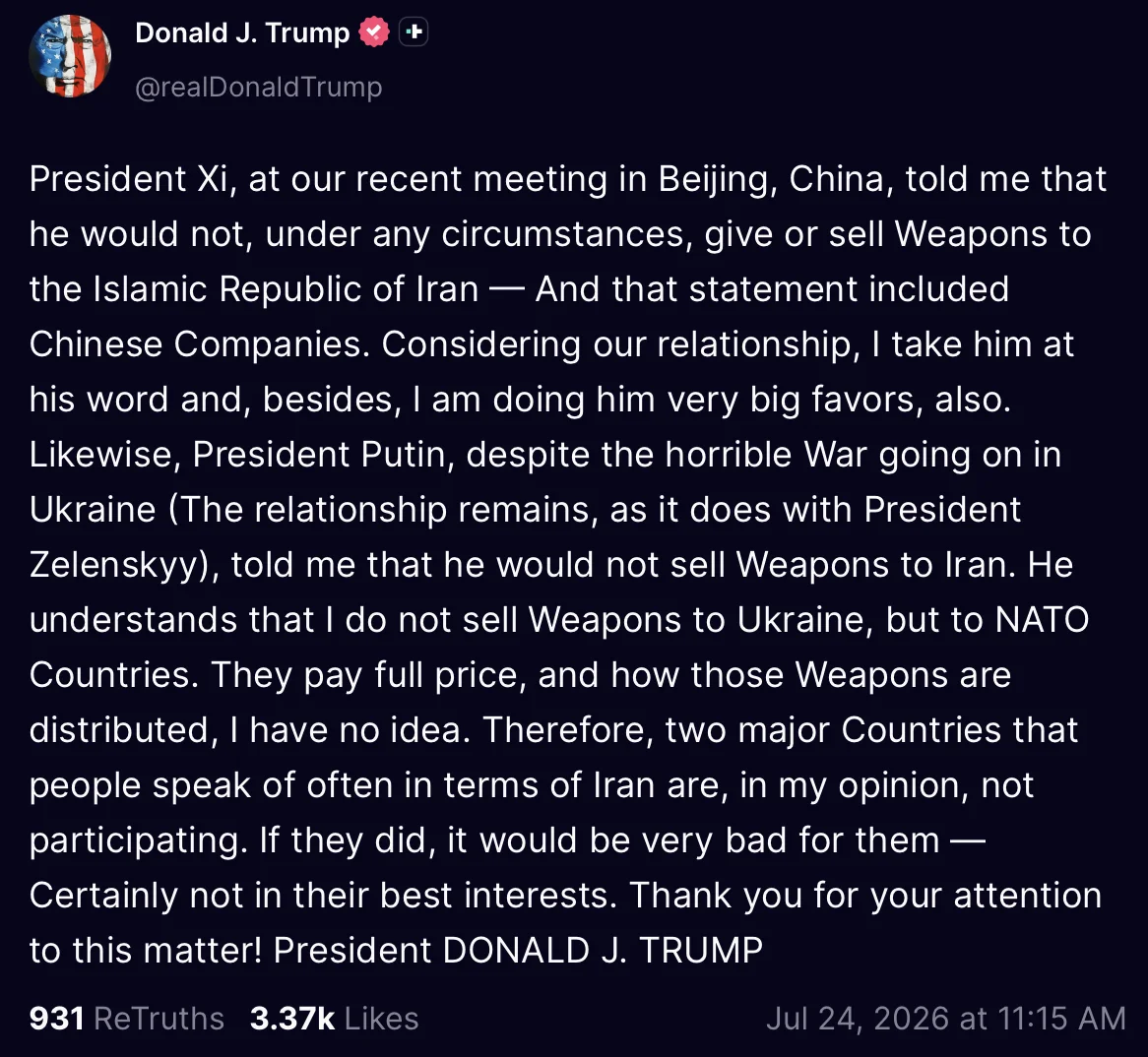
President Donald Trump has recently attempted to tamp down on world war speculation. In a social media post Friday he tried to distance the involvement of world powers with their proxy wars.
President Xi, at our recent meeting in Beijing, China, told me that he would not, under any circumstances, give or sell Weapons to the Islamic Republic of Iran — And that statement included Chinese Companies. Considering our relationship, I take him at his word and, besides, l am doing him very big favors, also. Likewise, President Putin, despite the horrible War going on in Ukraine (The relationship remains, as it does with President Zelenskyy), told me that he would not sell Weapons to Iran. He understands that I do not sell Weapons to Ukraine, but to NATO Countries. They pay full price, and how those Weapons are distributed, I have no idea. Therefore, two major Countries that people speak of often in terms of Iran are, in my opinion, not participating. If they did, it would be very bad for them — Certainly not in their best interests. Thank you for your attention to this matter! President DONALD J. TRUMP
While the President has claimed the proxy wars are generally disconnected from their world power enablers, the facts paint a different picture.
Washington continues to provide targeting intelligence via its satellite network to Kiev, even after Trump assumed power in 2025. Moscow began providing the same intel to Tehran after the Iran war began in early 2026.
According to a March 24 report in The Wall Street Journal, Russia has been directly supplying Ukraine with weapons and other goods.
“An Israeli strike on a naval outpost in the Caspian Sea targeted Russia’s support for Iran in the war, hitting a supply line that the countries have used to move ammunition, drones and other weaponry, people familiar with the matter said,” The Wall Street Journal said. “Last week’s strike was Israel’s first ever on the world’s largest inland sea. Far beyond the reach of the U.S. Navy, the sea connects Russian and Iranian ports about 600 miles apart, giving the countries a place to freely swap weapons along with goods such as wheat and oil.”
Russian Foreign Minister Sergey Lavrov recently said that the United States is directly involved in the recent Ukrainian strikes against targets within Russia.
“The Americans, through arms supplies paid for by the European Union, the provision of intelligence, the Starlink system and much more, are not simply helping, but are directly participating in guiding Ukrainian weapons toward targets, including civilian targets, on Russian territory,” Lavrov said Wednesday.
One of the major targets of the global conflict has been energy infrastructure. Some have called the war an “energy world war.”
The U.S. and Israel have hit Iranian energy targets while Tehran has struck gulf nations’ energy infrastructure. Russia has struck Ukrainian energy targets while Kiev has attacked Moscow’s energy targets.
The ongoing closure of the Strait of Hormuz and the recent partial closure of the Bab el-Mandeb Strait further intensify the energy squeeze.
The last conflict to become global in nature did so after the U.S. cut Japan off from energy supplies and froze their financial assets, eliciting a military operation from Tokyo against U.S. naval assets in Hawaii.
EBSCO reported:
The freezing of Japanese assets refers to a significant economic measure taken by the United States and its allies in July 1941, aimed at impeding Japan’s military actions during the Second Sino-Japanese War and its expansion in Southeast Asia. This decision came in response to Japan’s aggressive military operations, which included the occupation of French Indochina and the signing of a military alliance with Germany and Italy. The freezing of assets effectively restricted Japan’s economic activities within the United States and hindered its trade relations globally, as many international transactions were settled through U.S. banks. In conjunction with an oil embargo announced shortly thereafter, Japan faced severe resource shortages, particularly in oil, which was vital for its military operations. This economic pressure left Japan with limited options: either to negotiate the lifting of sanctions by withdrawing its forces or to engage in direct military conflict. Ultimately, Japan chose the latter path, leading to the attack on Pearl Harbor on December 7, 1941, which marked a pivotal moment in the escalation of World War II. The freezing of Japanese assets remains a critical example of how economic sanctions can influence military strategies and international relations.



One Response
…interest in developing longer term partnerships across the defense and tech sectors.
Money.
This is what this theater is all about.
Piss poor actors too.