


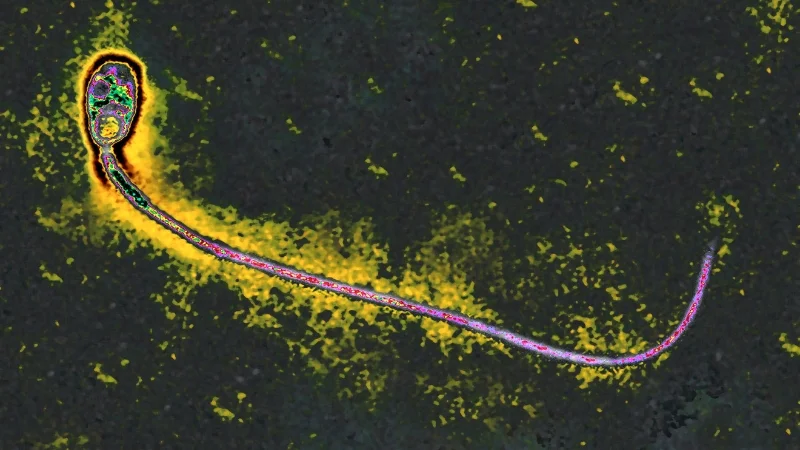


Scientists have taken the first step towards creating artificial sperm in a lab.
A study, published in the journal Cell Stem Cell, details how precursor cells were created using stem cells from humans and monkey.
Science website MedicalXpress explains, “The researchers started with induced pluripotent stem cells (iPSCs) from humans and rhesus macaques, which are blank-slate cells that can be programmed to become almost any cell type. By exposing them to specific chemical signals, the researchers transformed them into primordial germ cell-like cells (PGCLCs), which are lab-grown versions of the earliest embryonic cells that eventually develop into germline cells, in this case sperm cells.
“Germ cells cannot mature on their own and require a supportive environment, or niche. To provide this, the researchers combined the human or monkey germ cells with supportive cells from mouse fetuses. Together, these cells self-organized into a three-dimensional structure called a xenogeneic reconstituted testis (xrTestis), which mimics the basic structure of a natural testis.
“Inside the mini-testis, seminiferous tubules began to form. These are coiled structures within the testes where sperm are made. What grew in this setup closely resembled both the appearance and gene activity patterns of real human germ cells during the early stages of sperm development.”
In recent years, there has been growing alarm about declines in male fertility parameters, and in particular falling sperm counts.
Professor Shanna Swan has warned, on the basis of current global trends, that the median man could have a sperm count of zero by the middle of the century.
This would mean one half of all men would produce no sperm, while the other half would produce so few they would be functionally infertile.
If such a “spermageddon” scenario were to be realized, it would mean natural reproduction could be impossible within a generation.
Professor Swan has blamed a wide range of factors for the collapse in sperm counts, including obesity and sedentary lifestyles, as well as growing exposure to a class of chemicals known as endocrine-disruptors, which upset the body’s natural hormonal balance.





8 Responses
Star gate huh? Where are the Asgards again?
Ive seen that type of stuff in horror movies…it always went sideways!
This is of Satan, period!
TrumpDeception can’t wait to give it a taste test.
Well, just give your wife a kiss and you can taste it for yourself 😉
You gobble goo.
He’s gonna buy it by the 55 gallon drums to sate his homosexual buttsex fantasies.
No doubt.