


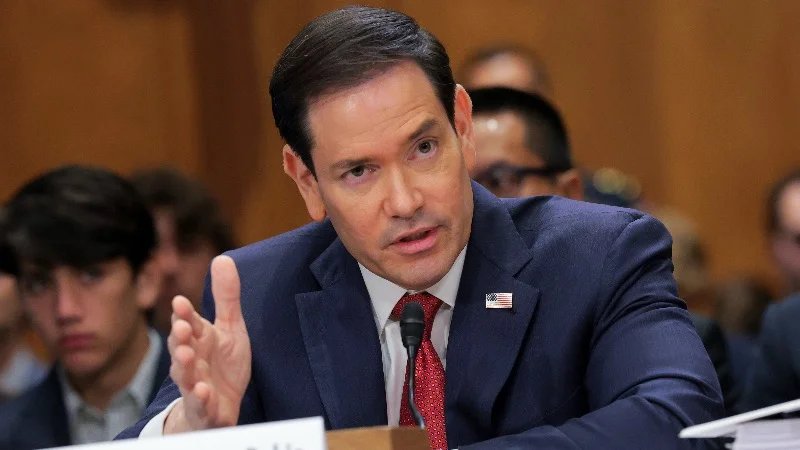


Secretary of State Marco Rubio said that President Donald Trump was aware of the potential economic impact of launching a war against Iran, but decided to take the risk in order to prevent Iran from attaining nuclear weapons.
“The president and the full administration was aware that there would be consequences to action, but the consequences of Iran having a nuclear weapon were worse,” Rubio said Wednesday at a House Foreign Affairs Committee hearing in Washington. “We were prepared for any response.”
The Organization for Economic Cooperation and Development [OECD] published a comprehensive economic outlook report Wednesday which warned of a global recession due to the closure of the Strait of Hormuz.
The 298-page report which says “under pressure” on the cover with an image of a car fuel gauge reading empty, painted a grim picture for a nation expecting a “golden age” under the Trump administration.
While the U.S. has a cushion of its own energy exports, growth is still expected to ease from 2.1% in 2025 to 2.0% in 2026 and 1.8% in 2027.
“The conflict in the Middle East has become the dominant force shaping the global economic outlook. Energy prices and the prices of other key agricultural and industrial inputs produced in the Persian Gulf economies have soared since February as production and exports have been curtailed. This has been pushing up inflation, putting pressure on real incomes and economic growth. GDP growth projections have been revised down, while inflation has been revised up,” a summary of the report said.
Looking into the future, an unresolved Iran war would deepen the global financial pain through stagnating business growth and sharply increasing inflation.
“However, the longer the disruptions last, the larger the economic and social costs become. Should the disruptions persist well into 2027, global growth is expected to slow significantly, to just 2.1% in 2026 and 1.8% in 2027, potentially pushing some economies into or close to recession. Unemployment would rise and investment – including in energy-intensive AI – would weaken significantly, with increasing risks of financial market repricing. Global inflation would rise by 0.4 percentage points in 2026 and 1.3 percentage points in 2027, with upside pressures from elevated commodity prices partially offset by weaker final demand. The consequences would be global but could prove especially severe for developing economies with limited energy reserves, higher shares of energy and food in household consumption, constrained fiscal capacity and weak social safety nets, low private savings buffers and more fragile currencies,” the full OECD report said on page 9, going on to explain how “many Asian economies would be hard hit in this scenario, reflecting their heavy exposure to energy supplies from the Middle East,” in a breakdown on page 13.
Page 19 covers the specific pressures that are being felt from the Iran war on people’s personal finances and in industry.
While Iran’s enriched uranium may have played a role in Trump’s decision to risk the global economy, it was also Israel’s decision to drag the U.S. into war.
In a May 14 interview with Sean Hannity, President Donald Trump admitted that the U.S. went to war with Iran for Israel, as well as for the Gulf state allies.
“We’re doing it to help Israel, and to help Saudi Arabia, and to help Qatar and UAE, and you know, Kuwait, and other countries, Bahrain,” Trump said.
The State Department has already confirmed the U.S. went to war for Israel.
“…the United States decided to act against the regime in collective self-defense of Israel,” the State Department said April 21.
On March 4 Trump acknowledged the fact that America struck Iran to defend Israel.
“And I think if we didn’t do it first they would have done it to Israel,” Trump said, referring the U.S. military strikes against Iran.
Trump also countered a statement by Secretary of State Marco Rubio about which country made the decision to attack Iran, the U.S. or Israel.
Trump was asked by a reporter on March 3 “Did Israel force your hand to launch these strikes against Iran? Did Netanyahu pull the United States into this war?”
“No. I might have forced their hand,” the President said.
A day earlier Rubio had a different story behind the war – that Israel made the decision to attack Iran, and that the U.S. was dragged in after it.
“The President made the very wise decision—we knew that there was going to be an Israeli action, we knew that that would precipitate an attack against American forces, and we knew that if we didn’t preemptively go after them before they launched those attacks, we would suffer higher casualties,” Rubio said March 2.

9 Responses
A recession is a “good thing” to people like Chump, Steve Forbes, and others of the venture capitalists class that swoop in like vultures to buy properties and assets for pennies on the dollar.
Sure, a little inflation or even a recession are not a big deal. The coming famine will be a lot worse though. This is where those of you stockpiling gold who think you are safe will trade all of it for a sandwich to keep you alive for just one more day.
Trump decided to bow down to Israel over helping the USA.
DJT is a total loss, further ties with Israel will undoubtedly lead to the complete destruction of the United States of America. They are financially manipulating elections and chipping away at the Constitutional rights of American citizens on a daily basis through the judicial system. Every news update coming out of the White House for the past month, up to this day, has been a complete lie. The truth is, Israel will never stop until there is all out war in the middle East and they EXPECT Americans to pay for it and bleed for it.
The State Department has already confirmed the U.S. went to war for Israel.
“…the United States decided to act against the regime in collective self-defense of Israel,” the State Department said April 21.
On March 4 Trump acknowledged the fact that America struck Iran to defend Israel.<<<<<<<<<<<<<<<<
But Alex says 'He's looking for an offramp to end the war'
Offramp? Did he have to look for an 'onramp' to start it?
But don't worry, since Trump called Netanyahu mean names and made sure the media got the transcript, that means its over
Iran’s the big dog in the Middle East without nukes. USA can’t protect Gulf States. They need to unit and kick America out of the Middle East for good!!!
If he did nothing then you retards would be complaining about how Americans and allies are getting nuked. It’s always lose -lose with you brown jobless losers.
Trump W.
It’s always brown brown brown with you, noisemaker.
Go read and write some comic books. Iran has no nukes and no nuke has been used in 81 years.
Learn reality instead of babbling nonsense.
If he did nothing then you retards would be complaining about how Americans and allies are getting nuked.<<<<<<<
The only country in the Mid east that has threatened to use nukes against the world is Israel
Its called the Sampson Option