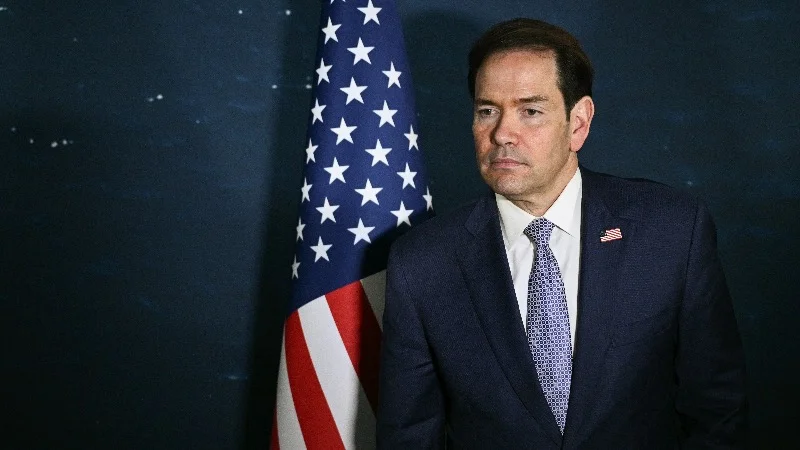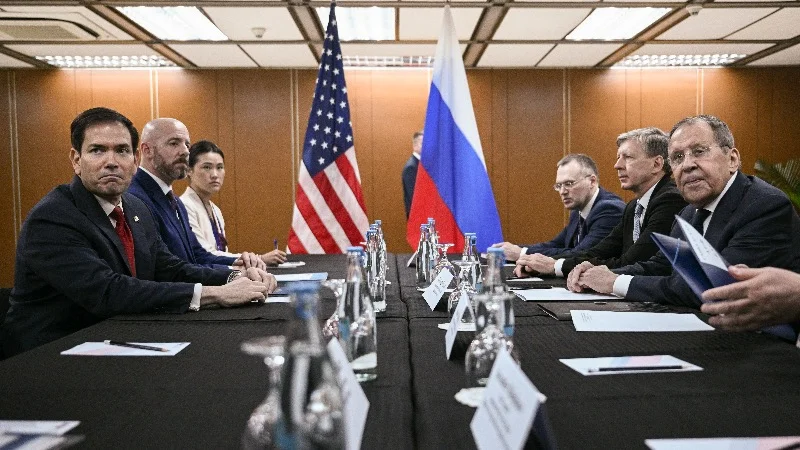


Secretary of State Marco Rubio and Russian Foreign Minister Sergey Lavrov met in the Philippines during the ASEAN summit on Thursday.
The U.S. and Russian officials discussed major international issues, such as the Ukraine war and Iran war during a 35-minute closed-doors talk. The meeting came at a critical time of escalation in both theaters of conflict.
Rubio reported that he had a “good” and “frank conversation” with Lavrov. Regarding the Ukraine war, the Secretary of State said that Washington was prepared to play a “constructive role” in helping to end the “senseless war.”
The Secretary of State also told the press that the Ukrainians won’t agree to a deal to end the war.
“I think both sides should have an incentive to bring it to an end,” Rubio said. “When peace comes, it would be because of some new ideas and some new concepts, and we are prepared to offer some of those in the right setting and forum if the opportunity presents itself and the conditions are right.”
NBC News Washington detailed the tone of Thursday’s meeting between the U.S. and Russian diplomats:
Before Rubio and Lavrov met, they ignored shouted questions from reporters about whether Russia was helping Iran by providing targeting data on U.S. locations in the region and when Russia would stop its war in Ukraine.
Lavrov did not answer questions but appeared to be challenging reporters by saying, “Speak louder,” even though the room was quiet and questions could be clearly heard.
When he left the meeting about half an hour later, Lavrov was asked again if Russia is helping Iran target U.S. troops.
“Nice hairstyle,” he said while staring at the reporter.
Russian Foreign Ministry spokeswoman Maria Zakharova said the two diplomats focused on bilateral relations and major international issues.
“While discussing the Ukraine crisis, she said Lavrov briefed Rubio on the ‘real state of affairs’ along the front line, warned against further arms deliveries to Kiev, and accused European countries of pursuing a destabilizing policy aimed at inflicting a ‘strategic defeat’ on Russia,” RT said. “Lavrov also reaffirmed Moscow’s readiness for a diplomatic settlement and its commitment to the U.S. proposals accepted by President Vladimir Putin at the summit in Anchorage, Alaska last year, she said. Zakharova stated that the two diplomats also welcomed the resumption of full-fledged contacts between Russia’s state space agency Roscosmos and NASA and supported expanding parliamentary and cultural exchanges. They discussed improving conditions for Russian and U.S. diplomatic missions and agreed to maintain contacts between their foreign ministries, including through international organizations.”
Territory issues continue to plague a negotiated end to the Ukraine war.
“Russia has since repeatedly said that it is prepared to agree to a ceasefire if Ukraine withdraws from its own territory in the Donbass region, which is partly occupied by Moscow,” Yahoo News said Thursday. “Ukrainian President Volodymyr Zelensky has repeatedly rejected such territorial concessions to Russia.”
Lavrov recently said that the United States is directly involved in the recent Ukrainian strikes against targets within Russia.
“The Americans, through arms supplies paid for by the European Union, the provision of intelligence, the Starlink system and much more, are not simply helping, but are directly participating in guiding Ukrainian weapons toward targets, including civilian targets, on Russian territory,” Lavrov said Wednesday.
While this relationship has been ongoing since the war began, Moscow’s public acknowledgment of it on Wednesday indicates the Kremlin may be signaling that it now views the U.S. as an enemy combatant in the war.
Moscow updated its nuclear doctrine in November 2024, when the Biden administration was allowing Ukraine to attack deep into Russia with long-range U.S. missiles. Those missiles were nuclear-capable, but had conventional warheads on them.
The revised doctrine allows Russia to launch a first-strike nuclear attack against nations which are party to conventional attacks against it.
With Moscow now acknowledging Washington as an active participant in the attacks against it, the Kremlin is effectively saying that the U.S. may be a valid target in a preemptive nuclear attack.