


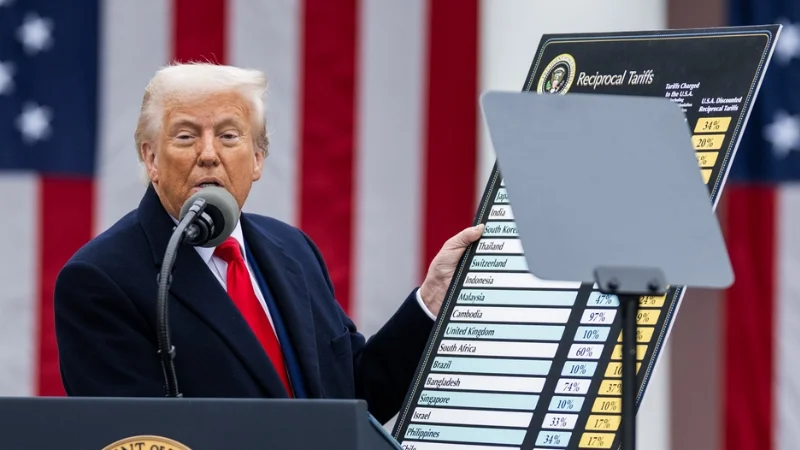


The Trump administration is appealing the latest court ruling against the President’s tariffs.
On Thursday, the US Court of International Trade, in a 2-1 decision, found that President Trump’s 10% global tariffs, imposed in February, were not justified under the 1974 Trade Act.
The court ruled the Act was not intended to address trade deficits where the US imports more goods than it exports.
The ruling resulted in a block on the tariffs for three importers that sued the Trump administration: two small businesses and the State of Washington.
The tariffs are due to expire in two months anyway, but the ruling is yet another setback for President Trump’s flagship economic program.
As Reuters notes, “It also sets the stage for another protracted legal battle over billions of dollars’ worth of tariff refunds, three months after the U.S. Supreme Court struck down Trump’s sweeping global tariffs imposed under a national emergencies law.”
Speaking to reporters on Thursday, President Trump blamed the decision on “two radical left judges.”
US Trade Representative Jamieson Greer said the administration expects to win the case on appeal.
In February, the Supreme Court ruled that President Trump had no authority to impose his earlier “reciprocal tariffs” under the International Emergency Economic Powers Act, a decision that led to the use of the 1974 Trade Act instead.
The new tariffs were only intended as a temporary measure.
The Trump administration is still planning to bring in a broader range of tariffs on its major trading partners using a third law, Section 301 of the 1974 Trade Act, which applies to “unfair trade practices.”
Three major investigations under Section 301 are due to be completed in July.
Support Alex Jones by picking up an all-new Alex Jones Live t-shirt, or a Trench War Dagger at TheAlexJonesStore.com.

2 Responses
Get that idiot, Zionist turncoat out of office ASAP.
War Profiteering
The charnel-house truth beneath the spreadsheets.
War profiteering is not merely about greed during conflict.
It’s what happens when organized violence becomes economically interoperable with institutional continuity.
Once war integrates into: employment, markets, industry, political legitimacy, strategic planning, and technological development peace stops being merely a moral issue.
It becomes a disruptive economic event.
###