


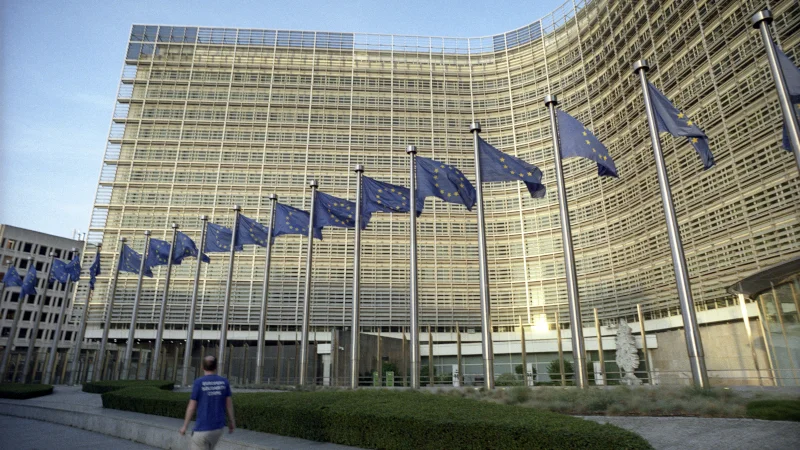


The European Union has built a powerful new sanctions apparatus — and according to German Bundestag member Rainer Rothfuss, it is raising increasingly serious questions about due process, legal certainty, and fundamental rights.
His criticism follows a parliamentary inquiry into the case of Berlin-based journalist Hüseyin Doğru, whose assets were frozen under EU sanctions. For Rothfuss, the case illustrates how an instrument originally presented as a foreign-policy tool is increasingly affecting individual citizens and even their family Embers.
Want to Sue the Government? Ask the Government for Permission First
Once an individual is placed on an EU sanctions list, assets can be frozen, making it difficult to finance a legal challenge against the measures.
According to the German government’s response to Rothfuss’s inquiry, sanctioned individuals may apply for permission to use frozen funds to pay legal expenses. In Germany, such requests are handled by the competent authorities.
The system creates a troubling situation in which sanctioned individuals may need government approval before accessing their own money for basic living expenses such as rent and food — or even to pay a lawyer and challenge the sanctions against them.
For Rothfuss, this creates a troubling situation: citizens seeking to challenge sanctions in court must first obtain authorization to access their own money for legal representation.
When asked how this arrangement can be reconciled with principles of effective legal protection and equality before the law, representatives of both the German Foreign Ministry and Justice Ministry declined to provide a substantive answer.
First the Journalist. Then His Wife. Now His Mother.
The controversy deepened when sanctions enforcement began affecting members of Doğru’s family.
Earlier, the bank account of his wife was frozen. A Berlin court later expressed serious doubts about the legality of that measure.
More recently, Doğru’s mother reportedly had her account frozen as well, with authorities citing a possible “control relationship” under sanctions regulations.
Critics argue that such measures risk creating a form of collective punishment by extending severe restrictions beyond the sanctioned individual himself.
When questioned, German ministries pointed to differing areas of responsibility, while no authority accepted political responsibility for the broader implications of the case.
EU Admits the Quiet Part Out Loud: It’s About “Behavioral Change”
One passage in the government’s response particularly caught Rothfuss’s attention.
The German government explicitly described sanctions as a foreign-policy instrument aimed at achieving “behavioral change” among targeted individuals.
For Rothfuss, this admission reveals the political nature of the sanctions regime.
“The government states quite clearly that sanctions are not primarily a legal instrument but a foreign-policy tool aimed at changing the behavior of those affected,” he argued.
He summarized the approach as “politically correct re-education through EU-sanctioned repression.”
Whether one agrees with that characterization or not, the statement has intensified debate over where the line should be drawn between legitimate foreign-policy measures and restrictions affecting individual rights.
Narratives, Influence Operations and Confidential Evidence
Another issue raised by Rothfuss concerns the grounds on which sanctions are imposed.
According to the government’s responses, sanctions decisions may involve allegations relating to the dissemination of certain narratives or participation in information manipulation and influence activities.
Critics argue that the relevant evidentiary packages remain confidential and are generally unavailable to the public. This lack of transparency, they say, makes meaningful scrutiny difficult and complicates legal challenges.
The government maintains that sanctions decisions are based on comprehensive assessments and established EU procedures.
A System That Admits Mistakes
The German government has also acknowledged that sanctions lists are subject to periodic review.
Several high-profile individuals were removed from EU sanctions lists in recent months, yet authorities provided little public explanation for either the original listings or the subsequent removals.
For Rothfuss, these cases demonstrate that errors can occur and that robust procedural safeguards remain essential.
Coming Soon: Making Sanctions Even Easier to Adopt
The debate is unlikely to fade anytime soon.
The German government has confirmed that it supports efforts to move certain EU foreign-policy decisions, including sanctions, away from unanimity and toward qualified-majority voting.
Supporters argue that such reforms would make the European Union more effective in responding to international challenges.
Critics, including Rothfuss, warn that removing the unanimity requirement would eliminate an important safeguard and lower the political threshold for imposing restrictive measures on individuals.
The “Rules-Based Order” Under Scrutiny
The European Union frequently presents itself as a global champion of democracy, transparency and the rule of law.
Yet cases such as that of Hüseyin Doğru have fueled growing criticism of a sanctions system that relies on confidential evidence, extensive financial restrictions and procedures that many critics view as insufficiently transparent.
Rothfuss argues that the debate over the legality and proportionality of EU sanctions is far from settled. The Doğru case, he says, demonstrates the urgent need for a fundamental review of how these measures are designed, justified and enforced.
For now, the sanctions remain in place. The legal and political arguments surrounding them do not.




4 Responses
EU is basically just
W
H
I
T
E
N
I
G
G
E
R
S
Doğru is a Russian propagandist and commie shill. Fuck off with this slop.
Shiieeeet
Hey, Shill! Unless someone is a spy you do not counter his opinions this way but by free speech to debate him. Your support for the thin edge of the wedge for the coming draconian EU total information repression is egregious and appalling. You are not a democratic defender of human liberty, but your piece is working for the tyrannical psychopathic scumbags who are hard at work in the EU implementing the New World Order. You belong in Hitler’s Third Reich or Stalin’s Soviet Union. Try living in the 21st Century and helping to save mankind and human civilisation. Or get lost.